Sunday, 15 December 2019

Bryophytes of Watlington Hill

Watlington Hill is a well-known site for chalk grassland bryophytes, although, despite this, relatively few recent records are available for the area (no post-2000 records for the main monad, SU7093, are in the BBS database or on the NBN Atlas for example). However, historically the site has been well searched. Ron Porley, when at English Nature, completed a thorough survey of the Hill in the early 90s, as a part of his work on the chalk grassland of the Chilterns. Porley found the Watlington & Pyrton Hill area to be the richest of the 13 sites he surveyed in terms of chalk grassland specialist bryophytes, recording 46 of his 69 such designated species at the site (although the site was also one of the largest in terms of the area of chalk grassland, estimated at 50.9 ha at that point).

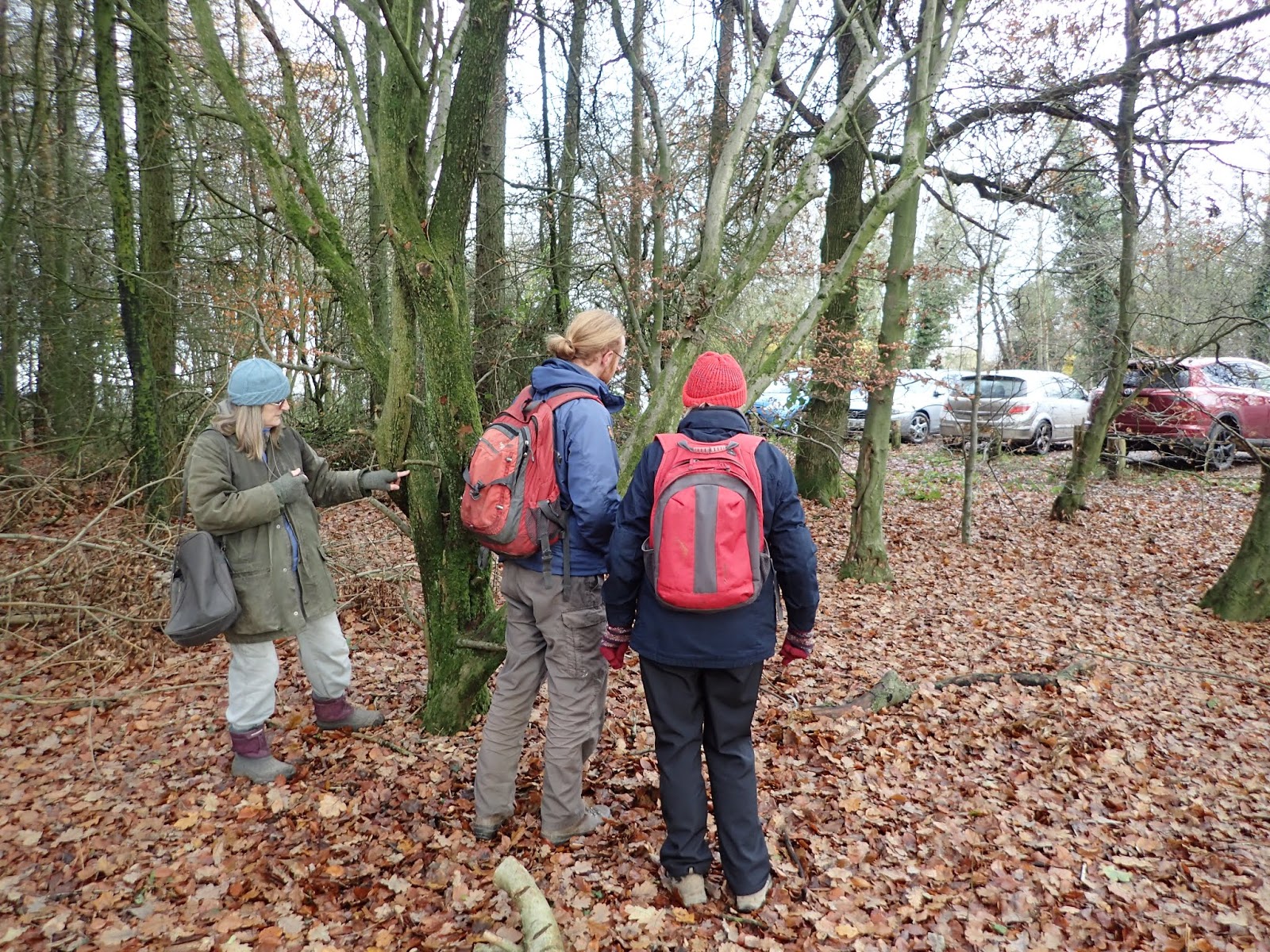
Therefore it was with high expectations that five bryologists assembled at Watlington Hill for the second excursion of the Oxfordshire mossing season (1st Dec. 2019). A number of our group were relatively new to bryophytes, so we started in the woods surrounding the main carpark, demonstrating some of the commoner feather-mosses (pleurocarps) and epiphytes (tree-dwelling bryophytes).

A gentle start to the day!
Our list rapidly swelled, with a number of epiphytes available to demonstrate, including the mosses Orthotrichum stramineum, O. affine, O. diaphanum, Cryphaea heteromalla, and Zygodon conoideus var. conoideus, and the liverworts, Radula complanata, Frullania dilatata, Metzgeria furcata and M. violacea. When I was learning bryophytes around Sheffield in the late 2000s, this would have been considered an impressive haul indeed (at that point, these species were still recolonising after having been previously eradicated from the area due to acidic pollution)! Soon after, David discovered a fallen ash with a superabundance of another epiphyte, Orthotrichum lyellii, a distinctive moss with many brown gemmae covering its leaves. Whilst we often find this on our outings, we normally only find small tufts on standing trees: no doubt our impression is biased by our vision and reach, as this supine ash demonstrated that this species can clearly become locally abundant further up trees!

Orthotrichum lyellii (middle distance) abundant on fallen ash
O. lyellii close-up, showing the brown gemmae


Progressing through the woodland along a track along the edge of the wood, a number of species typical of soil or tree roots were found. The most handsome probably being the liverwort Porella platyphylla, which tends to be found on old limestone walls, graves, hard chalky soils, and the roots of trees on such soils in the Oxfordshire district.

Porella platyphylla on beech root at Watlington.
After lunch, we emerged into chalk grassland, and most of the rest of the excursion was spent crawling around this habitat, as proven by Joshua's tweet below...
A trampled path through the grassland provided us with our first chalk grassland specialists, including Microbryum curvicolle (no photo, but a nice illustration can be found here). Fissidens dubius, Weissia longifolia var. angustifolia, and the tiny stone-covering Seligeria calycina were all also found along this track or in grassland nearby, as well as several other currently infertile small cushion mosses (acrocarps). The idea of returning in the early spring was floated at this point!

Moving into a larger area of grassland on an east-facing slope, David soon located Entodon concinnus, a lovely species normally indicative of rich turf.

Entodon concinnus at Watlington
Sure enough, other species such as Trichostomum crispulum, Hypnum lacunosum and Ctenidium molluscum were all nearby. Mounting the brow of the hill, we encountered the more acid clay-with-flints that often heralds local concentrations of calcifugous species (i.e. those that prefer acid soils). Dicranum scoparium, Polytrichum juniperinum, and P. piliferum were all found in this area.

On circling back to the car park, more rich calcareous turf was found on west and north-west facing slopes, including Ditrichum gracile, Campylium protensum, Plagiomnium affine, Rhytidiadelphus triquetrus, and Brachythecium glareosum. The last was confirmed microscopically back at home, as was Brachythecium salebrosum found in the wood near the carpark at the start of the day. Other species confirmed microscopically included Bryum klinggraeffii, B. ruderale, B. rubens, Fissidens viridulus and Zygodon viridissimus. There were a number of Watlington rarities that we didn't find, but these will hopefully be targeted on the 2020 spring visit previously mentioned! The full list from the day is below.

Ditrichum gracile in chalk grassland at Watlington.
Amblystegium serpens Fissidens dubius Polytrichum piliferum
Barbula convoluta var. convoluta Fissidens incurvus Pseudoscleropodium purum
Barbula unguiculata Fissidens taxifolius Rhynchostegium confertum
Brachytheciastrum velutinum Fissidens viridulus Rhytidiadelphus squarrosus
Brachythecium glareosum Homalothecium lutescens Rhytidiadelphus triquetrus
Brachythecium rutabulum Homalothecium sericeum Seligeria calycina
Brachythecium salebrosum Hypnum cupressiforme var. cupressiforme Syntrichia laevipila
Bryum capillare Hypnum cupressiforme var. lacunosum Syntrichia ruralis var. ruralis
Bryum klinggraeffii Hypnum cupressiforme var. resupinatum Thuidium tamariscinum
Bryum rubens Isothecium myosuroides Trichostomum crispulum
Bryum ruderale Kindbergia praelonga Ulota bruchii
Calliergonella cuspidata Leptobryum pyriforme Weissia brachycarpa var. obliqua
Campylium protensum Microbryum curvicollum Weissia longifolia var. angustifolia
Campylopus introflexus Mnium hornum Zygodon conoideus var. conoideus
Ceratodon purpureus Orthotrichum affine Zygodon viridissimus var. viridissimus
Cryphaea heteromalla Orthotrichum diaphanum
Ctenidium molluscum Orthotrichum lyellii Cephalozia bicuspidata
Dicranella varia Orthotrichum stramineum Frullania dilatata
Dicranum scoparium Oxyrrhynchium hians Lophocolea heterophylla
Didymodon fallax Plagiomnium affine Metzgeria furcata
Ditrichum gracile Plagiomnium undulatum Metzgeria violacea
Entodon coccinus Plagiothecium nemorale Porella platyphylla
Eurhynchium striatum Polytrichum juniperinum Radula complanata

Wednesday, 4 December 2019

Bryophyte season kicks off in the Lye Valley

In a joint effort to be more organised and transparent, this season all our meetings are on the blog calendar! We will be emailing around the details of meetings a few days in advance, if you are on David's botanical mailing list, you'll get them. If not, get in touch!

Our first meeting of the season was to the eastern suburbs of Oxford to visit the Lye Valley (SP5405), incorporating the Local Nature Reserve of the same name. This site used to be known as Bullingdon Bog, and as such is something of a locus classicus for Oxonian botany. It was, for example, the site where L'Obel made the first record of Parnassia palustris for Britain; it was recorded by Sibthorp and Boswell, and featured in early ecological work on calcareous fens by Roy Clapham (later lead author of the primary British Flora in use from 1958 up to the early 90s, when it was superceded by Stace).

A view along the Lye Valley LNR
A view along the Lye Valley LNR. (O.L Pescott, CC0).
It seems that we are lucky to still have the site in the reasonable condition that it is in. Eustace Jones in the early 1950s commented that "Bullingdon Bog which must once have been an ideal example of a calcareous valley bog, is now a disturbed fragment lying in the middle of an Oxford housing estate, and obviously cannot survive much longer." Although the site was scrubbed over in recent years, and the valley sides slumping due to scouring of the valley bottom by a storm drain outflow directed along the stream, excellent management work has taken place in recent years, and is gradually restoring the valley mire to its former glories (thanks to David Morris for this information).

Bryologists assemble! (O.L. Pescott, CC0).
But to the bryophytes! We dropped into the valley from Coverley Road, recording the woodland and along the stream before the beginning of the LNR proper. Many common species were quickly found, including Tortula subulata on friable soil, and Rhyncostegiella tenella on stone. Along the stream the thallose liverworts Lunularia cruciata and Pellia endiviifolia were growing in close association at the bottom of a concrete embankment. An odd amblystegioid growth was also scraped from concrete, which, under the microscope, seemed to match descriptions of the coastal variety of Amblystegium serpens var. salinum. This, however, would be an odd turn-up for Oxford, and must await confirmation from the BBS Recorder for Mosses! Subsequently an old Hawthorn turned up a rich crop of epiphytes, including the ever expanding (and beautiful) species Orthotrichum stramineum and Syntrichia papillosa. An uncertain Ulota was later checked at home, but turned out to be the commonest taxon (at least locally) U. bruchii.

After lunch the reserve proper was tackled, and a new list was begun to ensure that records made would be traceable directly to the LNR. Many epiphytes and common species were again quickly added, including a number that chose to grow on the synthetic wood of the reserve boardwalk (Syntrichia latifolia, S. montana, S. virescens, Orthotrichum affine, O. diaphanum, among others). Next was the fen proper, and many of our expected species began to accumulate (Plagiomnium elatum, Cratoneuron filicinum, Palustriella commutata, P. falcata, Campylium stellatum, Fissidens adianthoides etc.) All previously known from the mire, but all lovely to see thriving. The curious epiphyte Platygyrium repens was also found on a pollarded willow along the stream. Deciduous branchlets of very fine leaves give this species a fuzzy appearance in the field.

Platygyrium repens at Lye Valley. (O. Pescott, CC-BY).
Some known species we failed to refind (e.g. we did not relocate Drepanocladus revolvens or Climacium dendroides), but many other species were added to the site list. A productive day, and a good start to the season.

The list of unique species seen was as follows:
?Amblystegium serpens var. salinum Platyhypnidium riparioides Brachythecium rivulare
Amblystegium serpens Rhynchostegiella tenella Bryum pseudotriquetrum
Barbula convoluta var. convoluta Rhynchostegium confertum Calliergonella cuspidata
Barbula convoluta var. sardoa Schistidium apocarpum s.l. Campylium stellatum s.str.
Brachythecium rutabulum Syntrichia laevipila Cirriphyllum piliferum
Bryum capillare Syntrichia papillosa Ctenidium molluscum
Bryum moravicum Tortula muralis Dicranoweisia cirrata
Cratoneuron filicinum Tortula subulata Didymodon fallax
Cryphaea heteromalla Ulota bruchii Fissidens adianthoides
Didymodon sinuosus Zygodon conoideus var. conoideus Fissidens incurvus
Fissidens bryoides Cololejeunea minutissima Orthotrichum lyellii
Fissidens taxifolius Frullania dilatata Palustriella commutata s.str.
Homalothecium sericeum Lophocolea heterophylla Plagiomnium elatum
Hypnum cupressiforme var. cupressiforme Lunularia cruciata Plagiomnium undulatum
Hypnum cupressiforme var. resupinatum Metzgeria furcata Syntrichia latifolia
Kindbergia praelonga Metzgeria violacea Syntrichia montana
Orthotrichum affine Pellia endiviifolia Syntrichia virescens
Orthotrichum diaphanum Radula complanata Thamnobryum alopecurum
Orthotrichum stramineum Platygyrium repens Cephalozia bicuspidata
Oxyrrhynchium hians
Oxyrrhynchium schleicheri
Palustriella falcata Lophocolea bidentata

Friday, 13 September 2019

Autumn recording


Rosa sherrardii at Meadow Farm. The main features visible are the forward-pointing sepals and strong straight prickles.

A full press, product of looking at roses at Meadow Farm
With the coming of the season of mellow fruitfulness, I have of late been thinking about all those brightly-coloured berries, drupelets, drupes, haws, hips and pommes in hedgerows and scrubby places. As readers familiar with my interests will anticipate, this has mostly focused on roses, but I have also been scratching my head over hawthorns and having a go at brambles. This blog post is about what I have been finding this autumn.

Roses were the main target for a recording meeting I ran at Meadow Farm Nature Reserve in Blackthorn. The highlight was Rosa sherardii (Sherard's downy-rose), a predominantly northern and western species which has largely disappeared from our area (see map below). Gareth Knass recently found it on the downs in the VC22 part of modern Oxfordshire, but except for the one bush at Meadow Farm I am not aware of any confirmed recent records for VC23. I have only otherwise seen the hybrid with R. canina from VC23 (R. x rothschildii, e.g. at Sydlings Copse). Gareth has taken many wonderful photos of roses — you can see his images of R. sherardii here.

We also found the hybrid between R. canina (common dog-rose) and R. micrantha (small-flowered sweet-briar) (R. x toddiae), which seems to be the first record for VC23 since 1930. There were also R. canina hybrids involving R. obtusifolia and R. tomentosa, which are quite widespread, as well as R. obtusifolia itself, which seems to be a more local plant. Other unusual hedgerow things included a big specimen of Salix cinerea subsp. cinerea, quite an uncommon plant in Oxon.

Oli Pescott and I spent an afternoon looking at roses around Hills Watlington, Pyrton and Shirburn on the Chiltern escarpment, another good area for roses (I blogged a couple of years ago about the rich rose flora at Aston Rowant). One of the most characteristic species is the downland rose R. rubiginosa (sweet-briar), which is quite uncommon as a native plant but is widely planted in hedgerows. With its strong apple smell, big hips with forward-pointing sepals and fiercely-armed stems it is one of the more straightforward species to identify. Oli and I also found a number of bushes at Watlington and Pyrton that at first looked like R. micrantha but that on closer inspection had a few small slender prickles (acicles) toward the ends of the flowering branches and irregularly-sized hips — these were the hybrid with R. rubiginosa. This was only recently found in Oxon, from Sydlings Copse, but these new finds suggest it may be more widespread.

Roses aren't all about hybrids, though they are certainly very common, and Oli and I saw a fine bush of R. tomentosa (harsh downy-rose) at the edge of Shirburn Wood. Recording for Atlas 2020 seems to have shown that this species is more common than previously indicated but that it is largely confined to the Chilterns, downy roses in the rest of the county being hybrids. We also had time to pay homage to the nationally scarce R. agrestis (small-leaved sweet-briar) at Pyrton Hill, which was rediscovered in the county in 2016.


Crataegus x subsphaerica at Watlington Hill (note the forward- directed sepals)
I have written a few times this year about about non-native shrubs that look similar to native species. So far, however, I have not introduced the non-native hawthorns. This was mainly because I hadn't seen many examples in Oxon, but this autumn I have seen quite a lot, and I encourage others to have a look while these things are at their most conspicuous. There are two taxa to look out for, Crataegus rhipidophylla (large-sepalled hawthorn) and its hybrid with C. monogyna which is called C. x subsphaerica and is the more commonly planted taxon (whether we also have the hybrid with C. laevigata I don't know). I have seen bushes of C. x subsphaerica that are pretty old so this taxon is likely to have been with us for a long time — there seems to be a lot of introgression with C. monogyna, which must explain why these things have been over-looked. Some bushes I have found can only have arisen from bird-sown seeds, so it may be widespread and not just confined to planted hedgerows.

As you will have guessed, the conspicuous features are the haws, which are larger than usual and the sepals stick up from the fruit. The haws are often a brighter shade of red than C. monogyna and more square-shaped. If you look at haws of C. monogyna you will see that the sepals are reflexed so that they lie against the haw and the sepals are short triangles with blunt tips — if you see a hawthorn with some haws with erect sepals and the sepals longer than wide and verging on acute, then you are probably looking at C. x subsphaerica. The leaves of this hybrid are similar to C. monogyna, though they are heterophyllous, and one can usually find some leaves that are broader toward the base and have more teeth, features of C. rhipidophylla. True C. rhipidophylla has leaves that look like similar to Sorbus torminalis (wild service tree). The descriptions and keys in the books suggest the differences are subtle but really they are quite striking, so don't be deterred!

The photograph to the right gives a good idea of what to look for. David Broughton has also blogged about hawthorns and has some good images — see here.

Tuesday, 13 August 2019

Atlas recording in Sutton

After a pretty ordinary Atlas recording session a fortnight ago, on Sunday we had a return of luck and the big lists of earlier in the season. Expecting again ordinary countryside around Sutton (SP40D), we were rewarded with over 320 taxa, a list that included many interesting native plants but that of course was boosted significantly by garden escapes and other aliens. As last time, I will single out the native look-alike shrubs in the hope that this will generate more records and demonstrate that these things are ubiquitous (last time we were far away in SP42F). Maybe I should put together a key to these things — if you'd find this useful or interesting then leave a comment below and I might consider it!

If you look in the floras and the literature about native look-alikes, you'll see that there is an alien taxon for just about every native hedgerow and woodland shrub in Oxon, and some, like the dogwoods I blogged about last time, have several. This meeting it was the turn of the guelder roses, a commonly planted hedgerow shrub (entirely inappropriately, the native Viburnum opulus being largely a plant of damp woods) and of which Sell and Murrell describe two non-native forms of the native species and two similar alien species. My practice had been to lazily assume that planted things were at least the native species, if perhaps cultivars, but confronted with strange-looking plants in the Sutton area I had to revisit this assumption. The native guelder rose is an elegant plant with quite thin yellow-green small and neatly toothed leaves — if you see anything with thicker or darker or larger leaves with strange shapes then consider V. sargentii (Asian guleder-rose) and V. trilobum (American guelder-rose). I think we had both on Sunday, new to the county but doubtless overlooked elsewhere. V. trilobum has odd-looking thick-stalked glands on the petioles (I had never even noticed that guelder roses had glands!) and the leaves on the upper parts of branches have the middle lobes longer than wide. V. sargentii is similar to V. opulus with sessile glands and the middle leaf lobes as long as wide or less, but the leaves are thicker and darker and less toothed (some other differences are also described in Stace and Sell and Murrell).

Continuing with aliens, but aliens we botanists are prepared to tolerate and even admire, we also had a good variety of arable weeds. A fallow field sported no fewer than five species of Chenopodium, with the common C. album (fat-hen) and C. polyspermum (many-seeded goosefoot), the less common C. rubrum (red goosefoot) and the quite scarce C. ficifolium (fig-leaved goosefoot) and C. hybridum (maple-leaved goosefoot). We also had Euphorbia exigua (dwarf spurge), both species of Kickia (fluellens) and the fairly rare Polygonum rurivagum (cornfield knotgrass). I wouldn't be surprised if the latter were a little under-recorded — look out for its eye-catching dark pink tepals and narrow leaves (sorry for not taking a photo).

We did quite well for aquatic plants too. A new pond had Potamogeton crispus (curled pondweed) and P. berchtoldii (small pondweed), and the aquatic liverwort Riccia fluitans which I had never seen in Oxon. Other waterbodies turned up Zannichelia palustris (horned pondweed) and four species of Lemna (duckweeds).

I can't touch on aquatic plants without announcing Judy Webb's excellent pondweed find last year, and which I visited last week because I couldn't quite believe it. I shall deliberately not reveal the exact location of the site, but it would be hard to believe that just about any location in Oxfordshire would be suitable for Potamogeton polygonifolius (bog pondweed) these days. A plant of acid waterbodies and wetlands, it was known once-upon-a-time from Shotover Hill and a small number of other sites with the acid geology that is rare in the county, but had not been seen for decades. Yet there it was, growing in a former limestone quarry with plants of mineral-rich wetlands, like Schoenoplectus tabernaemontanii (grey clubrush) and the moss Campylium stellatum. The national pondweed referee Chris Preston was sensibly circumspect in not confirming the identification from my photographs, but I am happy to announce it now and possibly be proven wrong!

All of the above shows how dynamic our flora is, perhaps a theme of many of my posts on this blog. With people constantly disturbing and changing the environment and many plants good at dispersal and able to take advantage of this (naturally or because we find them attractive or otherwise useful), it is important and fascinating to record these changes and underscores the value of projects like Atlas 2020. So, please keep those records coming!