Showing posts with label rare plants. Show all posts

Saturday, 13 June 2020

Further county resurrections

This is a brief post to share some recent exciting finds of weeds in Oxfordshire. First, Anna Dudley contacted me to tell me about a population of Descurainia sophia (flixweed) that she had found at the M40 services at Waterstock. This plant was last recorded in the county in 2005 and it has always been very rare, really only a casual with us. It is a relatively common arable weed in East Anglia. If you'd like to see it, you will find it in a flower bed at SP62500478.

Surely the find of the season is Oli Pescott's discovery of a large population of Torilis arvensis (spreading hedge parsley) growing in a fallow field in Crowmarsh Gifford. This is an endangered and nationally scarce plant that had been thought to be extinct in Oxfordshire. The field is conveniently located by a footpath that passes a large number of plants at SU6171089298. The field is doubly worth a visit as there is an astonishing display of Centaurea cyanus (cornflower), another endangered arable weed, and very rare now except as an introduction. There is also Euphorbia exigua (dwarf spurge) and Filago vulgaris (common cudweed). Sadly the field is earmarked for development.

Monday, 20 April 2020

Lockdown botany


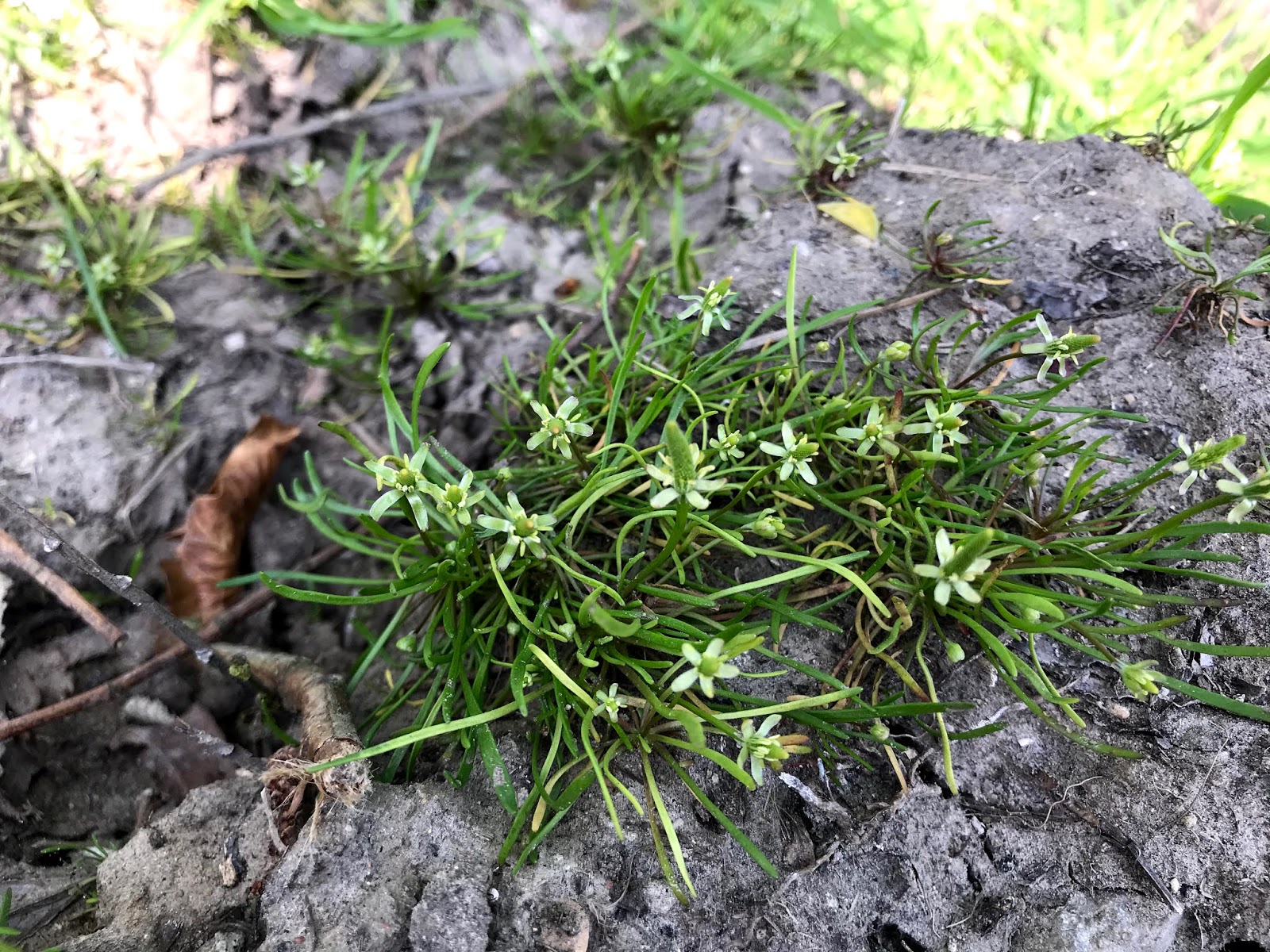
Myosurus minimus found by Roger Heath-Brown in Garsington. Image by Roger Heath-Brown
I wonder what the ageing George Claridge Druce, great man of early twentieth century botany, did with himself during the Spanish Flu pandemic of 1918. Did he self-isolate at his home in north Oxford and work on The Adventive Flora of Tweeside (published 1919) or revisions to his Flora of Oxfordshire? Or did he potter about the town and along his local rivers, seeking the solace of wildflowers? I hope it was as sunny and floriferous for Druce and his contemporaries as it fortunately has been for us these last weeks.

I toyed with the idea of working on an (online) flora, but this seemed like too serious an enterprise for such a serious (and ridiculous) time. So, as I like to imagine Druce would have (in order not to make myself feel inadequate in comparison with his considerable industry), I have been exploring my local area more thoroughly than I have had time for in recent years. What have you been up to? I hope you have been able to get out and be cheered by spring wildflowers during your permitted exercise. A few botanists have been in touch with interesting things they've found this spring. I have had a few myself, and so I thought I'd write a blog post in an attempt to spread the cheer. Do leave a comment below if you have had a nice find you'd like to share.


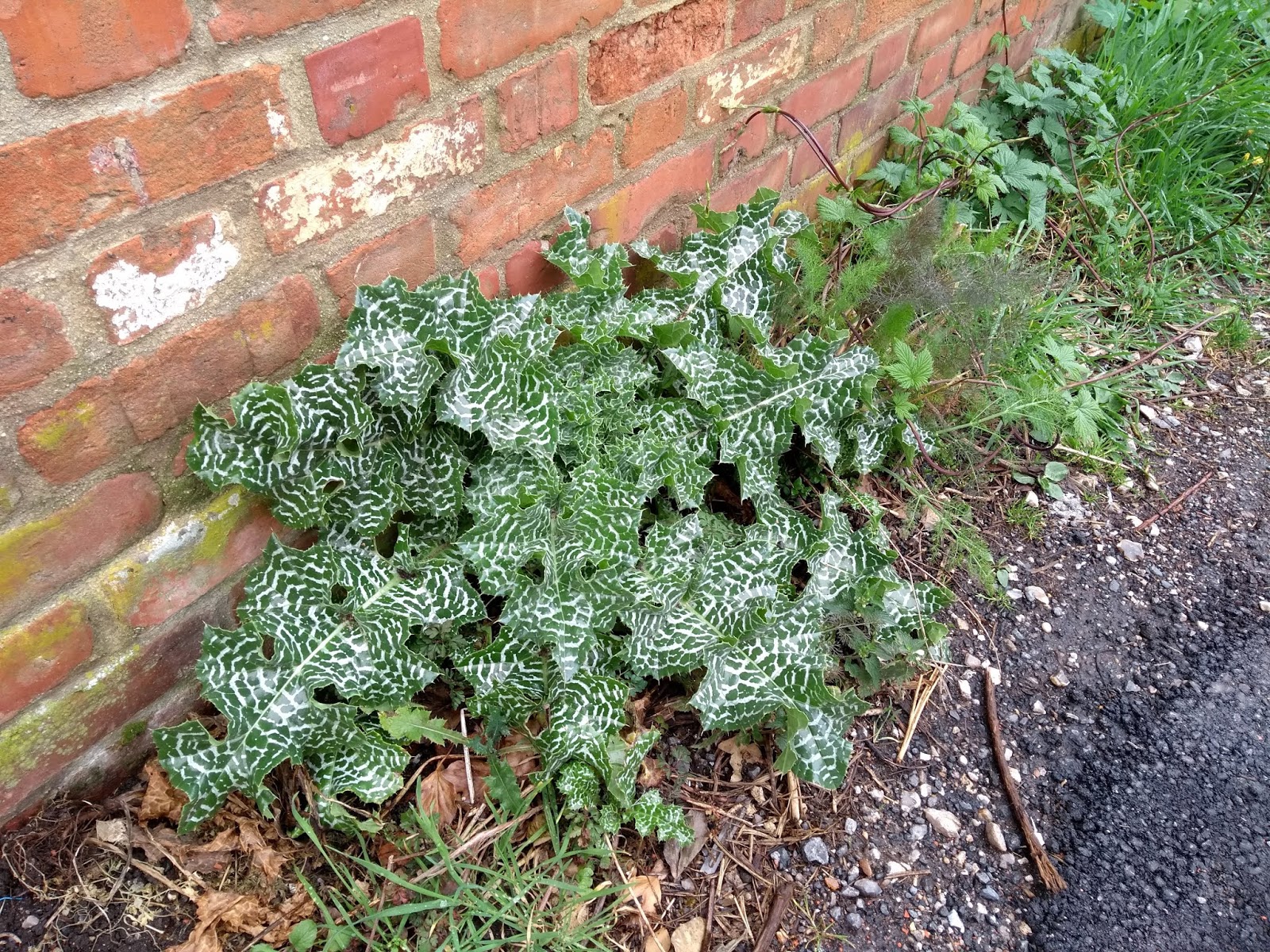
Silybum marianum in a Wallingford alley. Image by Oli Pescott
First up, Roger Heath-Brown and Fay Banks separately emailed me about a new population of Myosurus minimus (mousetail) they'd both seen on their walks around Garsington. Originally found by Roger, plants were growing in a damp cattle-trodden field corner. This and similar places such as gateways are the typical habitat of this locally scarce species. Over the last few years I have also found a few new sites for this plant, all in gateways, mostly in the upper Ray, such as at Meadow Farm.

Oli Pescott tells me that on his explorations of the back alleys of Wallingford he has been finding a lot of Silybum marianum (milk thistle) and that it appears to be spreading. Over the river in the vice county of Oxfordshire, there certainly seems to be a trend also, with many recent records of a species that formerly was rather rare and casual in the county. Oli suggests that this Mediterranean native may benefit from climate change. If you'd like to see it, there is a large well-established population on the Dyke Hills at Dorchester. Do let me know if you find any elsewhere.


On her daily walk around Kidlington, Judy Webb found a plant not seen in Oxon for a long time, and only ever known from the Stonesfield area. This was the little grass Poa bulbosa (bulbous meadow-grass), which Judy found growing abundantly on a dry road verge, together with other coastal species such as Plantago coronopus (buck's-horn plantain). I wonder how it got here? With its fragile bulb-like stems, perhaps fragments were spread with mowers? It would be interesting to investigate if it is present elsewhere in the neighbourhood. I went to have look myself (on my way to do my grocery shopping) and found also a lot of Cerastium semidecandrum (little mouse-ear) growing with it, a locally uncommon or overlooked spring annual of short dry grassland (it turns brown and disappears after May).

Judy's colony of Poa bulbosa growing on a road verge in Kidlington. The plants are the yellowed patches around the edges of the verge in the left hand image. The bulbous bases are clearly visible in the image on the right. Images by Judy Webb.

Taraxacum berthae a new county record found by Judy Webb. Note the spotty leaves and adpressed outer involucral bracts. Image by Judy Webb
Like Judy and me, and other botanists stuck at home, you might have spent this period of lockdown looking at dandelions, the last few weeks being the perfect time of year for identifying these cheerful little plants. Judy's lockdown botany has continued to yield interesting plants, with her inspection of verges in Kidlington turning up a new county record, Taraxacum berthae (Bertha's dandelion). Judy shared her find of this unusual dandelion on Twitter and had it excitedly identified by keen taraxacologists Alex Prendergast and Josh Styles and confirmed by the BSBI referee. This is a rare dandelion of the north-west, so what it's doing in Oxon is a mystery. Was it introduced or could it be a relic of the old meadows that much of modern Kidlington is built on?

The fen dandelion T. palustre has for many years had a special allure for me, growing as it does in one of my favourite kinds of habitat (fenny meadows) but it has so far alluded me. Historically, there were four sites for this now endangered dandelion in Oxon, last seen in 1978. I have wanted for a number of years to look for it in the two sites that haven't been destroyed, Otmoor and Wendlebury Meads, both local to me, but I have always been too busy in April when dandelions are on show. Well, no problem with lack of time this year, and I found it surviving at both sites. It is difficult to estimate numbers since you can only really identify plants in flower and it is a small plant, but the populations seemed quite small, around a dozen flowers at Otmoor and half that at Wendlebury.


While looking for fen dandelion, I also found quite a lot of T. anglicum (English dandelion) in a different area of Otmoor, a new site, and at Wendlebury Meads growing with T. palustre, where it was last seen many decades ago. Nationally this is a much rarer dandelion but Oxford is a hotspot, with a number of sites in damp ancient meadows. My finds prompted Judy to send me a photo of a specimen she collected from Alvescot Meadows near Carterton which she thought was T. anglicum, and indeed it was (though I'm no expert). This is a significant westward extension of its Oxfordshire range.

If you are not convinced that dandelions are interesting, then I challenge you not to be impressed by the photos shown. Gorgeous little plants!

I wouldn't go as far as to say 'thank goodness for lockdown', but it's great to start the year with two county resurrections and a new county record. Fingers crossed for more good finds once this is over.

T. anglicum (top) and T. palustre (bottom) found at Wendlebury Meads. The narrow leaves and adpressed involucral bracts are characteristic of Section Palustria. The dark narrowly bordered bracts and deeply divided leaves of T. anglicum are diagnostic, the opposite situation obtaining in T. palustre with wide borders to the bracts and hardly divided leaves.

Tuesday, 13 August 2019

Atlas recording in Sutton

After a pretty ordinary Atlas recording session a fortnight ago, on Sunday we had a return of luck and the big lists of earlier in the season. Expecting again ordinary countryside around Sutton (SP40D), we were rewarded with over 320 taxa, a list that included many interesting native plants but that of course was boosted significantly by garden escapes and other aliens. As last time, I will single out the native look-alike shrubs in the hope that this will generate more records and demonstrate that these things are ubiquitous (last time we were far away in SP42F). Maybe I should put together a key to these things — if you'd find this useful or interesting then leave a comment below and I might consider it!

If you look in the floras and the literature about native look-alikes, you'll see that there is an alien taxon for just about every native hedgerow and woodland shrub in Oxon, and some, like the dogwoods I blogged about last time, have several. This meeting it was the turn of the guelder roses, a commonly planted hedgerow shrub (entirely inappropriately, the native Viburnum opulus being largely a plant of damp woods) and of which Sell and Murrell describe two non-native forms of the native species and two similar alien species. My practice had been to lazily assume that planted things were at least the native species, if perhaps cultivars, but confronted with strange-looking plants in the Sutton area I had to revisit this assumption. The native guelder rose is an elegant plant with quite thin yellow-green small and neatly toothed leaves — if you see anything with thicker or darker or larger leaves with strange shapes then consider V. sargentii (Asian guleder-rose) and V. trilobum (American guelder-rose). I think we had both on Sunday, new to the county but doubtless overlooked elsewhere. V. trilobum has odd-looking thick-stalked glands on the petioles (I had never even noticed that guelder roses had glands!) and the leaves on the upper parts of branches have the middle lobes longer than wide. V. sargentii is similar to V. opulus with sessile glands and the middle leaf lobes as long as wide or less, but the leaves are thicker and darker and less toothed (some other differences are also described in Stace and Sell and Murrell).

Continuing with aliens, but aliens we botanists are prepared to tolerate and even admire, we also had a good variety of arable weeds. A fallow field sported no fewer than five species of Chenopodium, with the common C. album (fat-hen) and C. polyspermum (many-seeded goosefoot), the less common C. rubrum (red goosefoot) and the quite scarce C. ficifolium (fig-leaved goosefoot) and C. hybridum (maple-leaved goosefoot). We also had Euphorbia exigua (dwarf spurge), both species of Kickia (fluellens) and the fairly rare Polygonum rurivagum (cornfield knotgrass). I wouldn't be surprised if the latter were a little under-recorded — look out for its eye-catching dark pink tepals and narrow leaves (sorry for not taking a photo).

We did quite well for aquatic plants too. A new pond had Potamogeton crispus (curled pondweed) and P. berchtoldii (small pondweed), and the aquatic liverwort Riccia fluitans which I had never seen in Oxon. Other waterbodies turned up Zannichelia palustris (horned pondweed) and four species of Lemna (duckweeds).

I can't touch on aquatic plants without announcing Judy Webb's excellent pondweed find last year, and which I visited last week because I couldn't quite believe it. I shall deliberately not reveal the exact location of the site, but it would be hard to believe that just about any location in Oxfordshire would be suitable for Potamogeton polygonifolius (bog pondweed) these days. A plant of acid waterbodies and wetlands, it was known once-upon-a-time from Shotover Hill and a small number of other sites with the acid geology that is rare in the county, but had not been seen for decades. Yet there it was, growing in a former limestone quarry with plants of mineral-rich wetlands, like Schoenoplectus tabernaemontanii (grey clubrush) and the moss Campylium stellatum. The national pondweed referee Chris Preston was sensibly circumspect in not confirming the identification from my photographs, but I am happy to announce it now and possibly be proven wrong!

All of the above shows how dynamic our flora is, perhaps a theme of many of my posts on this blog. With people constantly disturbing and changing the environment and many plants good at dispersal and able to take advantage of this (naturally or because we find them attractive or otherwise useful), it is important and fascinating to record these changes and underscores the value of projects like Atlas 2020. So, please keep those records coming!

Saturday, 8 June 2019

Broughton Casttle


The first meeting of June and the fifth of the season was held last weekend at Broughton Castle near Banbury. This site had been recorded previously for Atlas 2020 but we had special permission to botanise the whole park and therefore hoped to refind some of the plants historically recorded but not seen since 2000.

I had particularly hoped that we might find some of the nice aquatic plants that had been recorded from the Castle Moat. As it turned out the moat was a brown soup with very few macrophytes, an unpleasant appearance completed by floating dead freshwater mussels. The Sor Brook was no better, sporting also the invasive non-native aquatic plant
Egeria densa
, the first reported sighting of this plant in Oxon for 35 years. Tributaries of the Sor Brook had some other infamous beasties, with
Fallopia sachalinensis
(giant knotweed) and its giant handkerchief-like leaves and
Heracleum mantegazzianum
(giant hogweed). On a positive, we did find quite a lot of
Ranunculus fluitans
(river watercrowfoot), which was good to see.

Elsewhere in the park plant diversity was quite limited. There was a decent stand of calcareous grassland with plants like
Cirsium acaule
(dwarf thistle),
Koeleria macrantha
(crested hair-grass) and
Helianthemum nummularium
(common rock-rose), but these had all been recorded previously. In all we managed to find about 250 taxa, bumping up the tetrad total to 338 from 252. Not the enormous haul of records of previous meetings, but eminently respectable and goes to show that even in well-recorded tetrads there is always more to find.

Interesting things have been turning up elsewhere in the county this spring. I was contacted independently by Frank Hunt and Andrew Lack after they both found a new population of
Scandix pecten-veneris
(shepherd's-needle) near Sandhills, north-east of Oxford. Frank also found a new population of
Montia fontana
(blinks), surprisingly at the well-botanised North Leigh Common. This time of year always produces some sore heads when the marsh orchids come out, and surveying a meadow in the VC 22 part of modern Oxfordshire Judy Webb and I found what with the help of BSBI Dactylorhiza referee Ian Denholm we determined as a swarm of
D. maculata
(heath spotted orchid),
D. praetermissa
(southern marsh orchid) and their hybrid D. x hallii. The latter was new to VC 22 and the modern county.

Botanising less obviously delightful places for Atlas 2020 near Adderbury, I found
Viola tricolor
(wild pansy) and, along the Oxford Canal,
Lepidium heterophyllum
(Smith's pepperwort). According to the Flora of Oxfordshire the latter has not been seen in the vice county since 1983! Not far away was possible Galium parisiense (wall bedstraw), but I want to check the fruits to be sure. This has not been seen in Oxon before, but was recently found new to Northants (VC 32), in the VC 32 part of Banbury and elsewhere.

The excellent Oxfordshire's Threatened Plants published last year reported that the small annual
Minuartia hybrida
(fine-leaved sandwort) had gone the way of many such plants and was extinct in Oxon. Fortunately not so, as the population known historically from the old chalk pit in Chinnor is still there, found by Paul Stanley back in 2013 and also seen by Oli Pescott, David Roy and myself while recording around Chinnor. The old pit has many other interesting plants, so do go and see this little delight while it is still out.

Monday, 20 May 2019

The Barfords


Carex rostrata (bottle sedge) growing in an artificial pond
Sunday continued the run of highly successful Atlas 2020 recording meetings in north Oxfordshire, when as a a fortnight ago we had another haul of 300+ taxa. Three of us met at Barford St Michael, downstream along the River Swere from where we last met, but it was a disappointing start, the churchyard of St Michael's proving among the dullest I have yet visited in Oxon. We later visited St John's in the same tetrad (SP43G), but it was even worse. However, we did find a single plant of
Rumex pulcher
(fiddle dock) in St John's churchyard, identifiable despite having been mangled by mowing, and last recorded there in 1989.

This tetrad was on my list of priority squares for Atlas 2020, with almost no post-2000 records and several locally rare plants reported in the Flora of Oxfordshire that are the only historic localities for these plants in the hectad (SP43), e.g.
Carex rostrata
(bottle sedge) and
Triglochin palustris
(marsh arrowgrass). As with previous meetings, therefore, the goal was to fill in this gap in the tetrad map and re-find plants for the hectad. As other recorders have found, relocating old records can be very difficult, with most records from the Flora available only as digitised card indexes with no locality information other than tetrad or hectad. Therefore, do remember that in order that future botanists do not have to share in this frustration, it is important that if you find a plant that is uncommon in the county, or even just within the tetrad you are recording, that you record a precise locality.

I had not realistically expected that we would refind many of the rarer plants, and as we were not spoiled with habitats as wonderfully plant-rich as last time, serious leg work was required to cover as much potentially productive ground as possible. As last time most of the good habitat was located along the River Swere, particularly a small area of wet grassland around a spring, home to the Triglochin we sought, as well as other wetlands plants such as
Caltha palustris
(marsh marigold),
Stellaria alsine
(bog stitchwort) and
Valeriana officinalis
(common valerian). The nearby floodplain of the Swere had
Carex nigra
(common sedge), also on my hectad wanted list,
Myosotis discolor
(changing forget-me-not) and other commoner floodplain plants.

I had assumed that the historic record of
Carex rostrata
would have been from the floodplain also but doubted there would be anywhere wet and unpolluted enough to still have it. As it was it we turned it up growing in abundance in a pond formed by damming of a small tributary of the Swere. Where did these plants come from? Willows along the edge of the pond, however, had clearly been planted, and included several quite large specimens of
Salix pentandra
(bay willow), a rare willow in Oxon and also on my hectad wanted list. Growing in pasture nearby was a bedstraw that had the habit of
Galium album
(hedge bedstraw) but with leaves on the narrow and suspiciously parallel side for this species — surely, the hybrid with
G. verum
,
G. x pomeranicum
? Some came home with me to see if it will produce the intermediately-coloured flowers that would clinch this determination. Although records indicate that it has always been rare in the county, do keep an eye out for this distinctive plant in meadows and pasture on calcareous soils.

A couple of closing thoughts on other harder to identify plants. Now is the best time of year to find and identify members of the
Poa pratensis
aggregate, with both
Poa angustifolia
(narrow-leaved meadow-grass) and
Poa humilis
(spreading meadow-grass) recorded on Sunday. Though quite distinctive plants (especially
P. angustifolia
) they are only really obvious in spring and early summer after which they are swamped by taller things — see the Plant Crib for descriptions. Finally, roses will be coming into flower over the next couple of weeks and one can start to provisionally put names to bushes (e.g. we had
Rosa obtusifolia x canina
on Sunday). It would be really great to have some more rose records for Atlas, so if you find a rose that might be a bit different (mainly things with glands and hairs) then do take photographs and I can provide some advice — the things to look for are summarised in the BSBI Yearbook under the referees section or in the roses handbook. You can see what roses have been recorded in your area by looking in the tetrad lists available via the Atlas progress map.

Note: The next meeting will be on June 1st, which is a Saturday rather than the usual Sunday. We have been given permission to explore the grounds of Broughton Park — please email me if you would like to come along.

Wednesday, 10 April 2019

And so it begins

The first recording meeting of the final season of Atlas 2020 in Oxfordshire was on Sunday. Meeting in Nether Worton in SP43, the location was evidently a little out of the way as there were only four of us, but if you thought that then you missed out on good botanising. Rather than the more usual square-bashing strategy, the aim of this meeting was to record an already quite well-recorded area in order to improve it further and also to pick up some plants that have not been seen this century in the hectad in Oxon, such as the woodland plants Viola reichenbachiana (early dog-violet) and Melica uniflora (wood melick). Previously these areas had been visited later in the year and we were therefore sure to pick up new things.

We started at the churchyard of the tiny church of St James' in Nether Worton (SP43F), a tetrad with a respectable post-2000 total of 168 but some missing vernal species. The churchyard was pretty undistinguished, with typical hangers-on of heavily-mown churchyard grassland such as Plantago media (hoary plantain) absent. There were plenty of naturalised non-natives to lend colour though, such as Cerinthe major 'Purpurescens', an annual bedding plant from the Mediterranean which appeared to have seeded from the adjacent garden and was a first for the county. There were also many plants of Ranunculus auricomus (goldilocks buttercup) here and in the nearby verges. We didn't stay long in the tetrad due to lack of promising-looking land accessible by footpaths, and instead headed west toward the Great Tew Estate via a detour north over Iron Hill Down (SP43A).

After a few kilometers on Iron Hill Down I was feeling pretty desperate as the place was an arable wasteland, though there were some springs with a few common wetland plants in one area. Crossing the B4031 south into the Great Tew Estate the spirits lifted, however, with a flurry of ticking of semi-natural woodland and grassland plants, like Sanicula europaea (sanicle) and Poterium sanguisorba (salad burnet). Thinking aloud I suggested that some nice grassland looked perfect for Ophioglossum vulgatum (adder's-tongue fern) and then promptly found several of the tiny fronds of this lovely vernal fern. Turned out this was a new hectad record!

Continuing into the valley bottom toward Great Tew we came upon a series of wet woodlands with springs and streams. Here we found a small population of Scirpus sylvaticus (wood club-rush), a scarce plant in Oxon. As a species of feruginous wet woodlands, this north-western part of the county with its iron-rich limestone is the main area where it has historically been recorded. The population we found was first seen in 2015. Some of the other highlights of this area included Polystichum aculeatum (hard shield-fern) and Hypericum maculatum (imperforate St John's-wort).

We concluded the meeting back in Nether Worton with a pretty diverse haul of records for early April. In total we collected 340 records of 236 taxa: 197 in SP43A and 127 in SP43F. This put the tetrad totals up from 214 to 284 in SP43A and from 168 to 214 in SP43F. Certainly better than I was anticipating after a pretty dismal morning! The next meeting will be on 21st April — I hope you can join me.

Monday, 23 April 2018

Cottisford


The 2018 recording season is truly upon us, and Sunday was the first of several Atlas 2020 recording meetings I will be organising this year. The target was far-flung Cottisford, an area in the north of the county I had never been to before, and I was joined by four other keen botanists for a delightful day botanising in glorious spring weather. I had identified this square (SP53V) as a target for recording using the interactive Atlas 2020 coverage map available here. Although the tetrad had around 150 taxa recorded it still had a low recording rate indicating there was much else to find, so the aim of the meeting was to focus on species and habitats not covered by previous records: as these were focused on the Cottisford Pond Local Wildlife Site (LWS), there was plenty other ground to cover. Notable plants to look out for included Astragalus glychyphyllos (wild liquorice), last seen in 1993, and Carex elata (tufted sedge), last in 1968. Read on to learn whether we found either!

We started off in the churchyard in the village, St Mary the Virgin, where we had the usual lawnmower-tolerant species of unimproved churchyard grassland such as Plantago media (hoary plantain). There was a single rosette of Dactylorhiza fuchsii (common spotted orchid) and an abundance of flowering Luzula campestris (field wood-rush), an understated spring beauty. Making out of the village for the area where the Astragalus was last recorded we came upon a few patches of flowering Rancunulus auricomus (goldilocks buttercup) in a hedgebank. Further along were scraps of limestone grassland with an abundance of Cirsium eriophorum (wooly thistle) and a few plants of Lithospermum officinale (common gromwell), which was new the to square. Also new was Hypericum maculatum (imperforate St John's wort), relatively scarce in Oxon, and further up the lane we found the sought-after Astragalus, much to our delight. There were a mere five small tufts of this species growing in a rather unprepossessing verge by a farm track.

The next few hours were spent wondering along footpaths picking up records from a variety of habitats. Two large fields of Linum usitatissimum (cultivated flax) provided many arable weeds, welcome as these are usually scarce so early in the year. The company disbanded after hunting out the plants of Cottisford village, where we found rather few garden escapees, and I headed out alone to the last recorded location of Carex elata. I was quickly disappointed as this was an arable field, but diving into the woodland in the shallow valley below I immediately found around 20 tufts in a spring-fed swamp - as Carex elata had been known from only one site in the county this was clearly a significant find! I continued to find further plants, keeping count until I came across a large area of flooded woodland that supported thousands of individuals, and I was puzzled as to how this plant had been missed here for fifty years! Several large tussocks were also growing in Cottisford Pond itself.

Right: a tussock of Carex elata growing in Cottisford Pond. Below left: its wet woodland habitat. Below right: a diagnostic feature of C. elata is the leaf-sheaths, which split into many ladder-like fibres.

The woodland around Cottisford Pond had plenty of other good plants to add to the list, with a range of ancient woodland and wetland species. Neottia ovata (twayblade) and Valeriana dioica (marsh valerian) were both new to the tetrad, the latter a surprise as I had never known this uncommon and threatened species to ever turn up at a new site or to grow in woodland. To the south above the valley, the woods on the hill and the small area of Shelswell Park within the tetrad added a good deal of further interest. This area supported acid grassland, a very rare habitat in Oxfordshire, and I was able to re-record Campanula rotundifolia (harebell), Cirsium acaule (dwarf thistle) and Galium saxatile (heath bedstraw) as well as add Carex caryophyllea (spring sedge), Filipendula vulgaris (dropwort) and Veronica officinalis (heath speedwell) new to the tetrad. The glacial sand and gravel deposits across this part of the county, from Hardwick north-east to Finmere and Mixbury, would certainly be worth further survey.

After a bit more back-and-forth along footpaths to try to pick up extra species, I eventually returned to Cottisford carrying a satisfyingly full recording card. Together the meeting bumped the tetrad up to a total of 300 taxa, recording 260 taxa and making 287 records, greatly exceeding my expectations. It was particularly gratifying to find so many new native species and few aliens for a change, and of course to re-record a number of locally important plants. Who knows what we will find in a forthnight's time at the next meeting on May 6th? Please email me if you'd like to join us.

Sunday, 15 April 2018

Atlas recording 2018

This is a short post to advertise opportunities to get together with local botanists this season and help with the penultimate season of recording for Atlas 2020. I will be organising recording meetings every other weekend through the season under the aegis of the Oxfordshire Flora Group, with the first meeting on Sunday 22nd April in the north of the county in Cottisford. I am also going to be running an 'official' BSBI meeting on 16th June, but so far my organisation hasn't progressed beyond fixing a date and the vague locality of the Chiltern Commons. Get in touch with me if you would be interested in coming along to any of these. The Wychwood Flora Group will also be running recording meetings in the west of the county, mostly on weekdays. Email the group if you are interested in joining any of their outings.

The above recording meetings and more are all listed in the events calendar which you can view here.

As a teaser for the kinds of plants you might see while out on a recording meeting, this is a photograph of the nationally scarce Helleborus viridis (green hellebore) that Oli Pescott and I found growing in great plenty along part of Grimm's Ditch near Nuffield in the Chilterns while we were out recording today. It was a very special sight and we found many other nice woodland plants, including Viola reichenbachiana x riviniana (=V. x bavarica), only the third county record. Is it overlooked in Oxon? Keep an eye out for intermediate-looking violets this spring!

Thursday, 8 February 2018

The year in botany


Recording plants at Somerton during a field meeting in May 2017
Now that we're well into the new year I thought it about time I had a look back at 2017. Much more happened during 2017 than can be summarised here — you can get an idea of local activities during the last year by reading the blog posts. If you've any highlights you'd like to share then consider leaving a comment below this post. It was a memorable year for me, not least as it was my first full year in the post of vice county recorder. I have enjoyed beginning to get to know the county's flora and its botanists, particularly through meetings (ten of which were covered on the blog). Numerous local botanists have also been out enjoying themselves outside of meetings, and it has been a pleasure receiving their records and learning what they've been up to. It has been particularly gratifying to see new recorders find their feet (there was a beginner recorders' meeting in April), and for me to be in a position to assemble everyone's contribution to Atlas 2020.

So far 13,623 records made during 2017 have been submitted to the BSBI Distribution Database (DDb). A further 4,114 records were submitted to iRecord, but these have yet to migrate over to DDb. iRecord submissions were almost double that of last year due to new recorders taking up this platform, but 13,623 is a bit of a dip for the DDb compared with 2015 and 2016 when over 24,000 and 25,000 were submitted, respectively. If you have records please therefore send them to me! I blogged earlier in the year about the the vascular plant record sharing agreement with Thames Valley Environmental Record Centre (TVERC), which was quite a big development, making a huge difference to the BSBI's Oxon data holding, with over 340,000 records received. Many recorders over the last couple of decades have preferred to send their records to TVERC, and being able to tap this activity has made a significant contribution toward Atlas 2020. It has been and continues to be a big job to check all these records but it is worth the effort!

I'm sure you're desperate to read how the county is getting on with Atlas 2020 following the 2017 recording season — the up-to-date tetrad (2km square) progress is shown in the map to the left, based on DDb records from the beginning of 2000 to present. This shows more clearly than maps I've previously published how survey effort has been expended, with both tetrad total taxa (tetrad colour) and total recording rate (tetrad size) illustrated. While coverage of the county has continued to improve, one can see that there is work to do in terms of consolidating the recording done to date, i.e. increasing the cover of 'bigger squares' (generally a recording rate of 60% requires about 200 taxa to have been recorded), and recording in the far-flung areas around the county boundary. This is essentially the message I've communicated previously, such as on the Atlas 2020 page, so we just need to keep on working at this up to the conclusion of the Atlas recording period.

The Oxford and Otmoor areas (SP50 and SP51) exemplify the situation we would ideally like to reach but as I've said before it is not essential or possible to fill every gap. At the scale of hectads (10km square), which will be the mapped units in the published Atlas 2020, most now stand at 50-60% recording rate or better (and similarly for the re-find rate), and most have at least 20% of tetrads with 100 or more taxa recorded, which is quite a good situation; targeted recording during 2018 and 2019, including repeat visits to tetrads, will improve the recording rate. Please do get in touch if you need help identifying areas for recording in your area.

Tetrad coverage for Atlas 2020, with tetrads coloured by number of taxa recorded since 2000, and square size scaled by total recording rate, i.e. the proportion of taxa recorded since 2000 out of all taxa recorded.


Above: Potamogeton nodosus in the Thames, Frank Hunt. Right: Carex muricata subsp. muricata in the Chilterns, Geoff Toone.
Now I come onto the less dry developments of 2017, the records of notable plants. The record that stands out of course is Frank Hunt's rediscovery of Potamogeton nodosus (Loddon pondweed) in the Oxfordshire part of the River Thames, a nationally rare species which had only ever been known in the county for a short period during the 1940s. Its reappearance in the Thames it turned out had actually already been established on the Berks and Bucks reaches of the river by the Environment Agency a few years ago, but this was still a very exciting record for Oxon. This rediscovery follows that of Rosa agrestis (small-leaved sweet-briar) in the county in 2016 — I hope that we may have a rediscovery every year!

Recording meetings during the year turned up many records of note. Less satisfactory was the grotty umbellifer found growing submerged in the River Cherwell during the meeting in Somerton in May: it was suspected to be Oenanthe fluviatile (river water-dropwort), thought extinct in the county, but later searching could not relocate it and its identity remains a mystery. On the same meeting was re-found a small population of the uncommon crowd-pleaser Saxifraga granulata (meadow saxifrage), a larger population of which was also rediscovered in December at Peppard chuchyard on the New Year Plant Hunt. With the county generally quite under-recorded, there are plenty of opportunities such as these for re-finding notable plants at old localities as part of Atlas recording, e.g. Fay Banks' Sambucus ebulus (daneberry) at Garsington this last year. Recording also turns up unusual or casual plants, and this year I had an odd weekend when several records of the locally rare Anthriscus caucalis (bur chervil) were sent to me.

Finally, a little-known Oxfordshire plant, the nationally rare Carex muricata subsp. muricata (large-fruited prickly sedge), came to my attention this year when I received a batch of records from Geoff Toone and Paul Stanley from back in 2011. Only discovered in the county early in the 2000s (I think at Hartslock, though I can't find the record), this sedge is beginning to emerge as potentially quite a widespread plant of Chiltern beechwoods, and many thanks are due to Paul, Geoff and others for continuing to track it down.

Wednesday, 3 January 2018

New Year Plant Hunt


Had you been in Peppard on Sunday you might have witnessed Oli Pescott and I striding about the parish, peering into hedges and self confidently looking over garden wall at weeds, for the hunt was on. The New Year Plant Hunt of course, the national scheme run annualy by the BSBI between 30th December and 2nd January, which challenges botanists to find as many wild plants in flower as possible in a continuous three hour period. With Oli for company I managed to do one better than my solo plant hunt which I blogged about last year, and further media coverage was provided with Oli tweeting about our hunt (left). I'd be delighted to hear by any means of other local Hunts, just be sure to submit your records here!

The choice of locality for our Hunt was not the shrewdest as the biggest yields of plants in flower are to be found in areas with a diversity of disturbed habitats, with an abundance of weeds and garden escapes, while Peppard is mostly semi-natural . I thought we'd make it a little bit more fun by seeing how many bryophytes we could find 'flowering' too (i.e. producing sporophytes), and we also kept full lists of both vascular plants and bryophytes! In all we had 20 species in flower, some maybe questionably so — do the cleistogamous flowers of Poa annua (annual meadowgrass) count, and can one ever actually tell whether the tiny-flowered and petal-less Aphanes arvensis (parsley piert) is in flower? In addition to the weeds and garden escapes we had the winter-flowering specialists, with Daphne laureola (spurge laurel) and a male plant of Mercurialis perennis (perennial mercury) on Peppard Common, and some early vernal species such as Ficaria verna (lesser celandine). The total was a few more than my 17 of last year, and better than the bryophytes of which we found only 16 with sporophytes, all commonly producing capsules at this time of year.

Not in flower but the star find of the day was unquestionably the unexpected colony of Saxifraga granulata (meadow saxifrage) in the churchyard of Rotherfield Peppard, seemingly mown with a razor blade. This species had not been seen in the tetrad since the 1960s and previous records (including that of Druce) were unlocalised, so a really good record of this uncommon plant. If you recall, flowering Saxifraga granulata was a highlight of one of the first meetings of the season, lending a nice symmetry to the year. There was further interest among the bryophytes when we found a tiny moss growing on a garden wall — after some head scratching it was suggested that our plants might be the first county record of Leptobarbula berica, but we await confirmation of this.

In total we recorded 173 vascular plant taxa, not a bad haul for December and valuable additional records for Atlas 2020, as well as 51 bryophyte taxa. Oli and I will continue botanising throughout the 'off season', and will next be meeting in Hinksey on the 7th. Please email me if you'd like to join us.

Above: flowering Daphne laureola (spurge laurel) (top) and a male plant of Mercurialis perennis (perennial mercury) (bottom), typical winter flowering plants, found during a New Year Plant Hunt. Right: the delightful sparsely hairy rosette leaves of Saxifraga granulata (meadow saxifrage) growing in All Saint's churchyard in Rotherfield Peppard.

Thursday, 21 September 2017

Loddon pondweed... IN THE THAMES!

I do not use capital letters lightly: the rediscovery of Potamogeton nodosus, the so-called Loddon pondweed, in the River Thames is really very big botanical news indeed! Otherwise known only from the River Loddon, the Bristol Avon and the Dorset Stour, this very rare pondweed was thought to have gone extinct in the Thames in the 1950s and there have been no Oxfordshire records for over 75 years. It was found by Frank Hunt back in August, near Marsh Lock, just south of Henley (SU774815), growing in a part of the river sheltered from boat traffic by a footbridge. Marsh Lock is less than 1km downstream from where it was seen by J.E. Lousley in 1941 and about 5km below where the Loddon joins the Thames. Frank also tells me that there is a patch in the the Berkshire part of the river too.

This is such a distinctive species that the referee for pondweeds, Dr Chris Preston, was quite happy to verify the record from the photograph shown right (and attributable to Frank).

Sunday, 2 July 2017

Middle Barton

Another successful recording meeting in SP42 last Sunday (apologies for the delayed write-up). After all those records from TVERC the hectad now looks relatively well recorded, but there were still no recent records from Middle Barton Fen SSSI (SP42N), so recording this site was the goal. With just three attendants we were able to cover ground quickly, getting round the site in good time so as to be able to also fit in a thorough bashing of SP42M.

Initially it didn't look positive that'd we get access to the SSSI so we wandered across nearby improved pasture. We made some surprising finds here on the slope above the fen, the first of which was Filipendula vulgaris (dropwort). There were also several rosettes of Cirsium acaule (dwarf thistle) and clumps of Ononis spinosa (spiny rest-harrow). The best find was Alchemilla filicaulis (hairy lady's-mantle), known at only four sites in the county and not seen at Middle Barton since 1987. After this splendid discovery access was confirmed to the SSSI!

The SSSI along a shallow valley of a small stream is in unfavourable condition, with much of it rank and overgrown with Filipendula ulmaria (meadowsweet). There was a little Dactylorhiza maculata (heath spotted orchid) in this vegetation, but the grazed neutral grassland on the valley slope was in good condition with plenty of nice plants, including Briza media (quaking grass), Dactylorhiza fuchsii (common spotted-orchid), Galium verum (lady's bedstraw), Potentilla erecta (tormentil), Poterium sanguisorba (salad burnet) and Succisa pratensis (devil's-bit scabious).

Another field within the SSSI still supported the distinctive fen meadow community dominated by Juncus subnodulosus (blunt-flowered rush) and Carex acutiformis (lesser pond sedge). Here the vivid green of rush and sedge foliage was splashed with the brighter colours of F. ulmaria and Silene flos-cuculi (ragged robin), as well as a mass of the pale straw-coloured inflorescences of J. subnodulosus. There was also an abundance of the scarce Valeriana dioica (marsh valerian), the un-valerian-like basal leaves forming an understorey to the rushes.

As we'd finished looking round the fen by lunchtime we next headed to SP42M which had only 80-odd post-2000 records. This tetrad supported a decent diversity of habitats, with wooded lanes, road verges, hedges, a churchyard, grassland and small streams with fenny areas, and we found a respectable 193 taxa. This bumped the tetrad comfortably over the 200 mark, including a few near-threatened species such as Knautia arvensis and relatively scarce ones such as Ranunculus fluitans (stream water-crowfoot).

For the next meeting on the 9th July we'll be back in SP42, returning to SP42Z. We were there way back in May and this time we'll be surveying Bestmoor SSSI which holds a large population of the nationally scarce Oenanthe silaifolia (narrow-leaved water-dropwort). Supposedly there are tens of thousands of plants and as well as count these I've been asked to survey the vegetation — I'll therefore be needing lots of help should you be able to spare a Sunday!

Sunday, 4 June 2017

Otmoor


The hybrid Viola x ritschliana between the nationally rare and critically endangered fen violet and the locally rare heath dog violet.
Otmoor Site of Special Scientific Interest was the venue for my latest recording meeting, held on bank holiday Monday. The area has been thoroughly botanised over the last few years so the purpose of the meeting was largely to have fun and see one of the finest wet grassland sites in the country, but I had hoped to add a few records. We were joined by members of the Reading and District Natural History Society. I didn't count but with Oxfordshire Flora Group regulars we made up an exceptionally large group (whom I kept waiting for twenty minutes when I mis-remembered the start time!).

I know the Moor well but this was only the second occasion I'd had to access the area around the MoD firing range. There are many wonderful things in there and for these we made a bee-line. As much as I enjoy recording meetings it was refreshing just to be able to walk somewhere with botanists without getting mired in recording all the plants one sees on the way!

Within the range the first species of interest was a weed, which I over-enthusiastically misidentified as the umbellifer Torilis arvensis (spreading hedge-parsley) on account of its hooked fruits. This is an endangered plant, severely declined in Oxon, and everyone got rather excited. Subsequent to the meeting I re-examined the plant and realised that it was instead Anthriscus caucalis (bur chervil), which also has hooked fruits. We all get things wrong sometimes, but this is still an interesting record! While not threatened A. caucalis has very few Oxon records, most of them old.

The author holding Anthriscus caucalis and looking pleased with himself despite being wrong

Tuesday, 16 May 2017

Somerton and the Oxford Canal

Botanists botanising by the Oxford Canal. Remark the use of modern technology. Image by Fay Banks
Recording for Atlas 2020 in Oxfordshire continues. The target of this Sunday's meeting was the county's most under-recorded 10km square, SP42. Earlier in the spring I wrote about a recording outing of mine in SP42 at Tackley, and this week the venue was the parish of Somerton in SP42Z, further north along the River Cherwell/Oxford Canal. There will be another meeting in SP42Z on 8th July at Bestmoor SSSI, when we will survey the huge population of the nationally scarce Oenanthe silaifolia (narrow-leaved water-dropwort).

Sporangia of P. interjectum x100, with few thick-walled (indurated) cells forming the annulus and two basal cells between this and the stalk
The five of us who met at Somerton were blessed with wonderful weather and some fabulous plants. We started at the churchyard of St James’ which was a tidy disappointment, however. An exhibitor at the church exhorted us to come in afterwards for coffee and artwork, but we conveniently forgot and instead went to the Bell Inn in Lower Heyford! The only interesting native species in the village was a large amount of the fern Polypodium interjectum (intermediate polypody) on a shaded wall. Contrary to previous records I am finding that this is a common fern of limestone walls in Oxfordshire. I’d be grateful if other recorders would check any Polypodium they find microscopically, or record it as P. vulgare sens. lat. rather than attempt an identification based on frond morphology as this is not reliable.

We left Somerton southwards across bright green agricultural grassland and wheat fields infested with Alopecurus myosuroides (black grass). At this point I began to worry about our species list. A short detour out of SP42Z into SP42Y gave us Senecio viscosus (sticky groundsel) by the railway, from where we looped back into our tetrad and picked up the Oxford Canal. From here our fortune turned.

Thursday, 23 March 2017

Blysmus intervention

Blysmus compressus grows in only one place in Oxfordshire (V.C. 23), in Old Marston within the complex of meadows and floodplain grassland along the River Cherwell designated as the Almonds Farm and Burnt Mill Meadows Local Wildlife Site. The population of Blysmus is quite healthy, extending over about 30m of the bank and with  thousands of inflorescences produced last summer. However, its future has been uncertain for several years with the cessation of grazing following the lapse of the previous tenancy and there has been no management for the last six years.

Not any more! This last weekend volunteers mowed the bank on which Blysmus grows in order to set back the coarse sedges and grasses beginning to overwhelm the smaller plants requiring shorter, finer vegetation, Blysmus included. Without this cutting Blysmus will eventually disappear under a thatch of coarse grasses and sedges, joining the list of Oxfordshire's extinct plants. Repeated again toward the end of summer and again in future seasons this management should result in a diverse sward of herbs and short sedges, just as it ought to look!

Many thanks to the volunteers who helped with this conservation intervention, to the owners Oxford City Council for their permission and assistance, and to the tenant farmer for his permission and sympathy for the cause of this threatened plant. Judy Webb who helped to organise the day has put some excellent photos and videos of scything in action on her website — except for the clothes and the kind of scythes used, the scene could be medieval.

Vegetation supporting Blysmus at Marston, dominated by grasses and with abundant Equisetum arvense and Potentilla anserina. According to results of the Threatened Plants Project the latter is a common associate of Blysmus compressus.

Saturday, 3 December 2016

Recording highlights from 2016

As the miserable weather settles on us and we enter the season of armchair botanising (at least for higher plants), I offer my reflections on what has been a very rewarding season. These highlights are based on exciting plants I've seen this year and range from new county records and new sites for county rare plants, to re-finds of plants thought potentially extinct in the county. I can think of many further delights I'd have liked to have included, but at least that leaves plenty of material for other posts. Do let me know if there's anything you'd like to share.