Our flora two centuries ago - the Flora Oxoniensis of 1794 by John Sibthorp has now been translated from the latin and is available on Fritillary Extra https://anhso.org.uk/wp-
Tuesday, 30 March 2021
Flora of 1794 Translated
Local plants need your help! Oxfordshire has been losing wild plant species at a rate of one a year, and many more are in dire straits. A band of volunteer Flora Guardians keep an eye on endangered populations and organize necessary management and propagation. Please use the contact box on https://anhso.org.uk/contact/ if you would like to hear more about endangered plants in your area, or other opportunities for helping the Oxfordshire Flora Group of the Ashmolean Natural History Society of Oxfordshire.
Saturday, 13 June 2020
Further county resurrections
This is a brief post to share some recent exciting finds of weeds in Oxfordshire. First, Anna Dudley contacted me to tell me about a population of Descurainia sophia (flixweed) that she had found at the M40 services at Waterstock. This plant was last recorded in the county in 2005 and it has always been very rare, really only a casual with us. It is a relatively common arable weed in East Anglia. If you'd like to see it, you will find it in a flower bed at SP62500478.
Surely the find of the season is Oli Pescott's discovery of a large population of Torilis arvensis (spreading hedge parsley) growing in a fallow field in Crowmarsh Gifford. This is an endangered and nationally scarce plant that had been thought to be extinct in Oxfordshire. The field is conveniently located by a footpath that passes a large number of plants at SU6171089298. The field is doubly worth a visit as there is an astonishing display of Centaurea cyanus (cornflower), another endangered arable weed, and very rare now except as an introduction. There is also Euphorbia exigua (dwarf spurge) and Filago vulgaris (common cudweed). Sadly the field is earmarked for development.
Sunday, 31 May 2020
English Botanical News and some local news

Tephroseris integrifolia at Aston Upthorpe. Kathy Warden

Cynoglossum germanicum growing at a newly discovered site, on the edge of Russell's Water Common
With the on-going restrictions on social gatherings, there is not much to report locally, though I am sure people are continuing to find nice things but not telling me.
With some of the restrictions being lifted, the Oxfordshire Flora Group's flora guardians are now able to continue their monitoring work. Kathy Warden has been searching for Tephroseris integrifolia (field fleawort) at its remaining site at Aston Upthorpe Downs in the vice county 22 part of modern Oxfordshire. Sadly it has been missing from v.c.23 for a very long time. It also seems to be much reduced on the Berkshire Downs based on Kathy's findings, but apparently it does not perform well in dry springs.
Fay Banks and I enjoyed a (socially distanced) botanical outing a fortnight ago, taking in Russell's Water, Maidensgrove and the Warburg Reserve. The latter is a honeypot site in the county but both it and the surrounding area had in fact not been well-recorded for Atlas 2020, so we had a lovely sunny walk in a beautiful part of the county, improved recording in this area (although too late for the Atlas project) and saw some great plants. The highlights included lots of the nationally rare Cynoglossum germanicum (green houndstongue) and Carex muricata subsp. muricata (large-fruited prickly-sedge). The former was a conservation introduction to the reserve in the 1990s, and which we found had spread to coppice plots around the reserve and up a lovely green lane to the common at Russell's Water.
Warburg was the original Oxon site for Carex muricata subsp. muricata (or just Carex muricata as some authorities would have it, all five members of the Carex spicata group deserving species status), found there in 2003. It particularly seems to like footpaths and we even found some at a new location a kilometre or so from Warburg, growing by the Chiltern Way footpath. Having spent a bit of time this spring comparing the different members of this locally data deficient group of sedges, it would be interesting to make a post-Atlas project out of them. See below for some comparative photos of four of the five members of the group (respectively, C. spicata, C. divulsa subsp. leersii, C. muricata subsp. muricata and C. muricata subsp. pairae).
Monday, 20 April 2020
Lockdown botany
I wonder what the ageing George Claridge Druce, great man of early twentieth century botany, did with himself during the Spanish Flu pandemic of 1918. Did he self-isolate at his home in north Oxford and work on The Adventive Flora of Tweeside (published 1919) or revisions to his Flora of Oxfordshire? Or did he potter about the town and along his local rivers, seeking the solace of wildflowers? I hope it was as sunny and floriferous for Druce and his contemporaries as it fortunately has been for us these last weeks.
I toyed with the idea of working on an (online) flora, but this seemed like too serious an enterprise for such a serious (and ridiculous) time. So, as I like to imagine Druce would have (in order not to make myself feel inadequate in comparison with his considerable industry), I have been exploring my local area more thoroughly than I have had time for in recent years. What have you been up to? I hope you have been able to get out and be cheered by spring wildflowers during your permitted exercise. A few botanists have been in touch with interesting things they've found this spring. I have had a few myself, and so I thought I'd write a blog post in an attempt to spread the cheer. Do leave a comment below if you have had a nice find you'd like to share.
First up, Roger Heath-Brown and Fay Banks separately emailed me about a new population of Myosurus minimus (mousetail) they'd both seen on their walks around Garsington. Originally found by Roger, plants were growing in a damp cattle-trodden field corner. This and similar places such as gateways are the typical habitat of this locally scarce species. Over the last few years I have also found a few new sites for this plant, all in gateways, mostly in the upper Ray, such as at Meadow Farm.
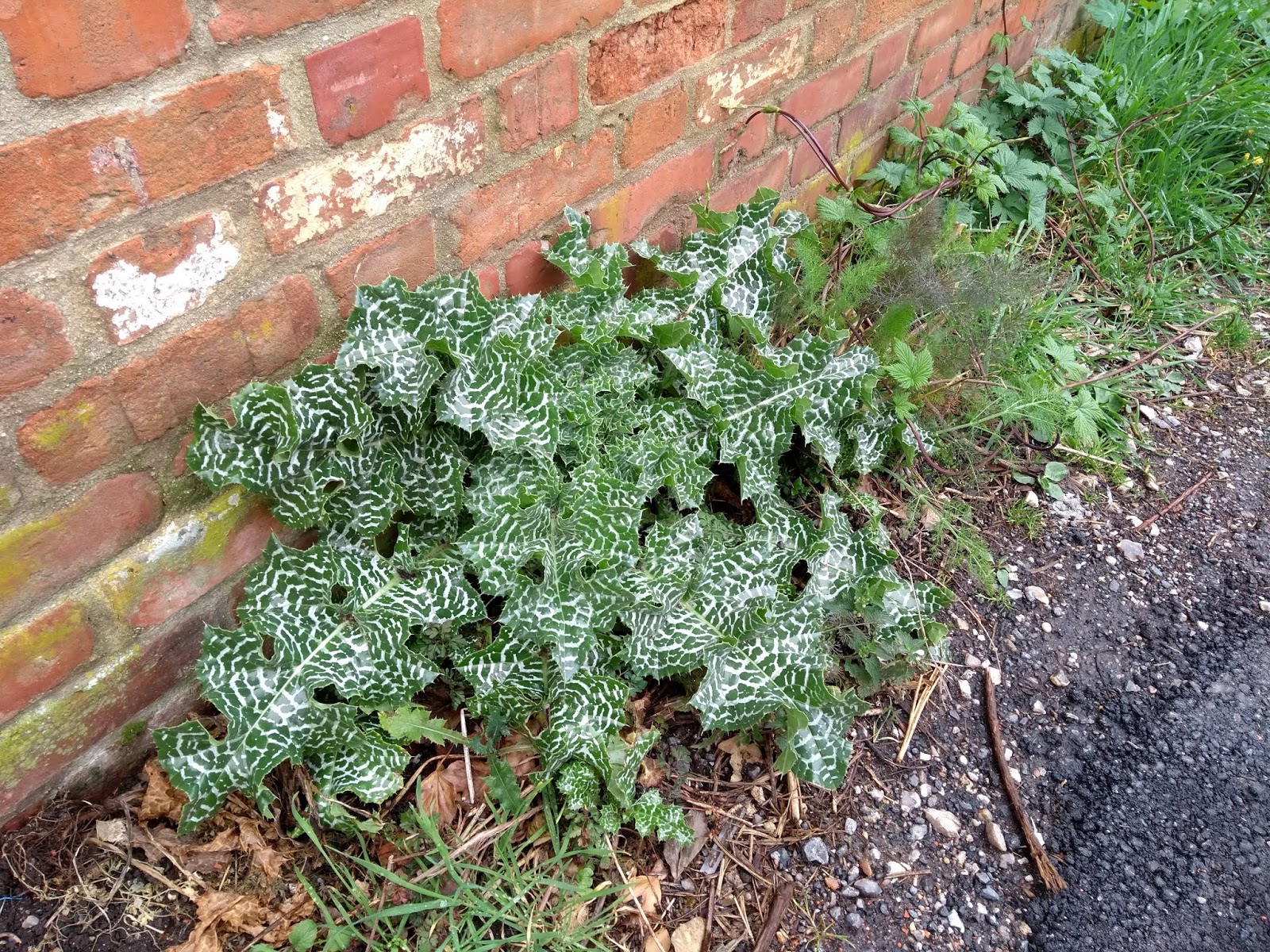
Oli Pescott tells me that on his explorations of the back alleys of Wallingford he has been finding a lot of Silybum marianum (milk thistle) and that it appears to be spreading. Over the river in the vice county of Oxfordshire, there certainly seems to be a trend also, with many recent records of a species that formerly was rather rare and casual in the county. Oli suggests that this Mediterranean native may benefit from climate change. If you'd like to see it, there is a large well-established population on the Dyke Hills at Dorchester. Do let me know if you find any elsewhere.
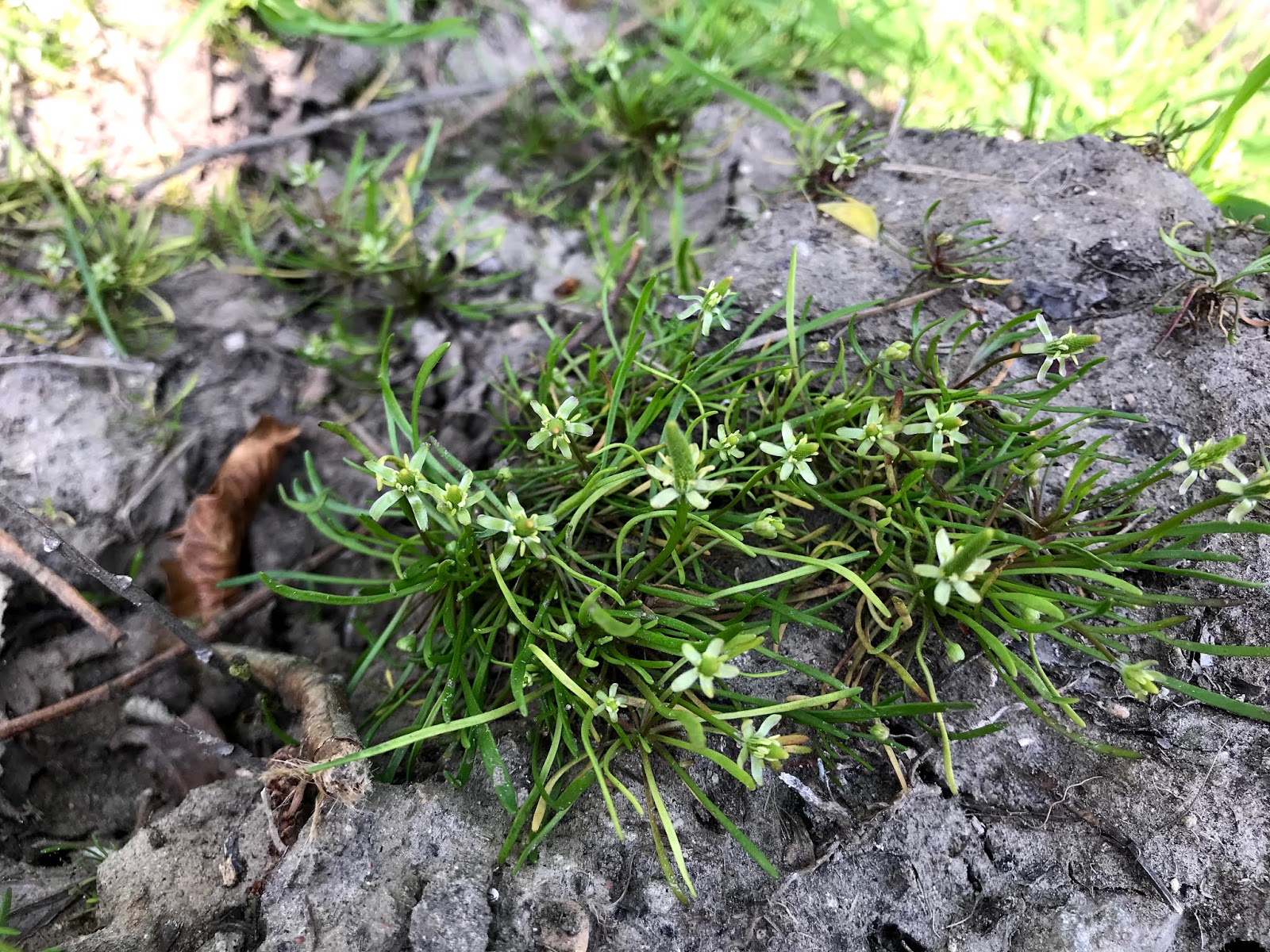
On her daily walk around Kidlington, Judy Webb found a plant not seen in Oxon for a long time, and only ever known from the Stonesfield area. This was the little grass Poa bulbosa (bulbous meadow-grass), which Judy found growing abundantly on a dry road verge, together with other coastal species such as Plantago coronopus (buck's-horn plantain). I wonder how it got here? With its fragile bulb-like stems, perhaps fragments were spread with mowers? It would be interesting to investigate if it is present elsewhere in the neighbourhood. I went to have look myself (on my way to do my grocery shopping) and found also a lot of Cerastium semidecandrum (little mouse-ear) growing with it, a locally uncommon or overlooked spring annual of short dry grassland (it turns brown and disappears after May).

Taraxacum berthae a new county record found by Judy Webb. Note the spotty leaves and adpressed outer involucral bracts. Image by Judy Webb
Like Judy and me, and other botanists stuck at home, you might have spent this period of lockdown looking at dandelions, the last few weeks being the perfect time of year for identifying these cheerful little plants. Judy's lockdown botany has continued to yield interesting plants, with her inspection of verges in Kidlington turning up a new county record, Taraxacum berthae (Bertha's dandelion). Judy shared her find of this unusual dandelion on Twitter and had it excitedly identified by keen taraxacologists Alex Prendergast and Josh Styles and confirmed by the BSBI referee. This is a rare dandelion of the north-west, so what it's doing in Oxon is a mystery. Was it introduced or could it be a relic of the old meadows that much of modern Kidlington is built on?
The fen dandelion T. palustre has for many years had a special allure for me, growing as it does in one of my favourite kinds of habitat (fenny meadows) but it has so far alluded me. Historically, there were four sites for this now endangered dandelion in Oxon, last seen in 1978. I have wanted for a number of years to look for it in the two sites that haven't been destroyed, Otmoor and Wendlebury Meads, both local to me, but I have always been too busy in April when dandelions are on show. Well, no problem with lack of time this year, and I found it surviving at both sites. It is difficult to estimate numbers since you can only really identify plants in flower and it is a small plant, but the populations seemed quite small, around a dozen flowers at Otmoor and half that at Wendlebury.
While looking for fen dandelion, I also found quite a lot of T. anglicum (English dandelion) in a different area of Otmoor, a new site, and at Wendlebury Meads growing with T. palustre, where it was last seen many decades ago. Nationally this is a much rarer dandelion but Oxford is a hotspot, with a number of sites in damp ancient meadows. My finds prompted Judy to send me a photo of a specimen she collected from Alvescot Meadows near Carterton which she thought was T. anglicum, and indeed it was (though I'm no expert). This is a significant westward extension of its Oxfordshire range.
If you are not convinced that dandelions are interesting, then I challenge you not to be impressed by the photos shown. Gorgeous little plants!
I wouldn't go as far as to say 'thank goodness for lockdown', but it's great to start the year with two county resurrections and a new county record. Fingers crossed for more good finds once this is over.
I toyed with the idea of working on an (online) flora, but this seemed like too serious an enterprise for such a serious (and ridiculous) time. So, as I like to imagine Druce would have (in order not to make myself feel inadequate in comparison with his considerable industry), I have been exploring my local area more thoroughly than I have had time for in recent years. What have you been up to? I hope you have been able to get out and be cheered by spring wildflowers during your permitted exercise. A few botanists have been in touch with interesting things they've found this spring. I have had a few myself, and so I thought I'd write a blog post in an attempt to spread the cheer. Do leave a comment below if you have had a nice find you'd like to share.
First up, Roger Heath-Brown and Fay Banks separately emailed me about a new population of Myosurus minimus (mousetail) they'd both seen on their walks around Garsington. Originally found by Roger, plants were growing in a damp cattle-trodden field corner. This and similar places such as gateways are the typical habitat of this locally scarce species. Over the last few years I have also found a few new sites for this plant, all in gateways, mostly in the upper Ray, such as at Meadow Farm.
Oli Pescott tells me that on his explorations of the back alleys of Wallingford he has been finding a lot of Silybum marianum (milk thistle) and that it appears to be spreading. Over the river in the vice county of Oxfordshire, there certainly seems to be a trend also, with many recent records of a species that formerly was rather rare and casual in the county. Oli suggests that this Mediterranean native may benefit from climate change. If you'd like to see it, there is a large well-established population on the Dyke Hills at Dorchester. Do let me know if you find any elsewhere.
On her daily walk around Kidlington, Judy Webb found a plant not seen in Oxon for a long time, and only ever known from the Stonesfield area. This was the little grass Poa bulbosa (bulbous meadow-grass), which Judy found growing abundantly on a dry road verge, together with other coastal species such as Plantago coronopus (buck's-horn plantain). I wonder how it got here? With its fragile bulb-like stems, perhaps fragments were spread with mowers? It would be interesting to investigate if it is present elsewhere in the neighbourhood. I went to have look myself (on my way to do my grocery shopping) and found also a lot of Cerastium semidecandrum (little mouse-ear) growing with it, a locally uncommon or overlooked spring annual of short dry grassland (it turns brown and disappears after May).
Judy's colony of Poa bulbosa growing on a road verge in Kidlington. The plants are the yellowed patches around the edges of the verge in the left hand image. The bulbous bases are clearly visible in the image on the right. Images by Judy Webb.
Taraxacum berthae a new county record found by Judy Webb. Note the spotty leaves and adpressed outer involucral bracts. Image by Judy Webb
The fen dandelion T. palustre has for many years had a special allure for me, growing as it does in one of my favourite kinds of habitat (fenny meadows) but it has so far alluded me. Historically, there were four sites for this now endangered dandelion in Oxon, last seen in 1978. I have wanted for a number of years to look for it in the two sites that haven't been destroyed, Otmoor and Wendlebury Meads, both local to me, but I have always been too busy in April when dandelions are on show. Well, no problem with lack of time this year, and I found it surviving at both sites. It is difficult to estimate numbers since you can only really identify plants in flower and it is a small plant, but the populations seemed quite small, around a dozen flowers at Otmoor and half that at Wendlebury.
While looking for fen dandelion, I also found quite a lot of T. anglicum (English dandelion) in a different area of Otmoor, a new site, and at Wendlebury Meads growing with T. palustre, where it was last seen many decades ago. Nationally this is a much rarer dandelion but Oxford is a hotspot, with a number of sites in damp ancient meadows. My finds prompted Judy to send me a photo of a specimen she collected from Alvescot Meadows near Carterton which she thought was T. anglicum, and indeed it was (though I'm no expert). This is a significant westward extension of its Oxfordshire range.
If you are not convinced that dandelions are interesting, then I challenge you not to be impressed by the photos shown. Gorgeous little plants!
I wouldn't go as far as to say 'thank goodness for lockdown', but it's great to start the year with two county resurrections and a new county record. Fingers crossed for more good finds once this is over.
T. anglicum (top) and T. palustre (bottom) found at Wendlebury Meads. The narrow leaves and adpressed involucral bracts are characteristic of Section Palustria. The dark narrowly bordered bracts and deeply divided leaves of T. anglicum are diagnostic, the opposite situation obtaining in T. palustre with wide borders to the bracts and hardly divided leaves.
Labels:
2020,
dandelions,
grasses,
rare plants,
roads,
verges
Sunday, 8 March 2020
Great bryophytes at Great Tew
Despite Storm Ciara pummelling parts of Britain, no less than five bryologists turned out for our trip to part of the Great Tew estate (the valley at the bottom of SP3730). In the event, despite getting rather wet, the valley sheltered us from the worst of the wind, and the only slightly hairy moment was the explosive crack of a branch coming down further along the valley.
And finally, a nice photo of the epiphytic liverwort Metzgeria violacea that seemed extremely happy in the humid environment of this hidden valley.
Oh, and for the non-bryologists, we also saw Dryopteris dilata growing epiphytically in the crown of a fallen oak, which is not a habitat most Floras list!
The full list of bryophytes seen in the valley at Great Tew is given below:
Although bryologists have visited the Great Tew area previously (e.g. Eustace Jones recorded Grimmia orbicularis on the estate, and mentions a record of Orthotrichum tenellum in a "wet wood in valley north of Great Tew" in his 1953 paper on the mosses of Berkshire and Oxfordshire), very few localised records actually exist in the database of the British Bryological Society (older records tend only to have been entered as hectad summaries). This, then, was a great chance to explore a private woodland (we had permission!) and make some localised records for an area that is not well-represented in records databases.
After picking up various common pleurocarps after dropping into the valley, we also found Isothecium alopecurum on the roots of ash and fertile Cirriphyllum crassinervium nearby on soil. Soon after we found one of the things that we had been hoping for, a tufa-forming stream emerging out of the valley-side, as is often found in cuttings and valleys on the Oolite in the north of Oxfordshire. This particular one was not particularly blessed with bryological interest, although a large stand of Palustriella commutata featured in the centre of the stream, accompanied by Cratoneuron filicinum and Pellia endiviifolia.
| Palustriella commutata clump in tufaceous spring |
Soon after, an uncommon sight in Oxfordshire was seen, that of Plagiomnium undulatum fruiting. Jones (1953) listed this species as "sterile" in Oxon., and still considered the fact of its fruiting "rare or very rare" after forty more years bryologising in the county (Jones, 1991).
| Plagiomnium undulatum in fruit at Great Tew. |
By this point of the day we were rather sodden, and thoughts were turning towards home. Perhaps the nicest thing of the afternoon was a good population of the liverwort Plagiochila asplenioides growing along a track through the wood further up the valley side. Whilst this livewort is fairly frequent in ancient woods on heavy basic soils, it is not common in Oxfordshire overall, and is always nice to see.
| Plagiochila asplenioides at Great Tew. |
| Metzgeria violacea |
Oh, and for the non-bryologists, we also saw Dryopteris dilata growing epiphytically in the crown of a fallen oak, which is not a habitat most Floras list!
| Dryopteris dilata growing as an epiphyte on oak (foreground; background fern is Polypodium interjectum) |
| Amblystegium serpens var. serpens | Hypnum cupressiforme var. resupinatum | Zygodon conoideus var. conoideus |
| Brachythecium rivulare | Isothecium alopecuroides | Conocephalum conicum s.str. |
| Brachythecium rutabulum | Isothecium myosuroides | Frullania dilatata |
| Bryum capillare | Kindbergia praelonga | Lophocolea bidentata |
| Calliergonella cuspidata | Orthotrichum affine | Metzgeria consanguinea |
| Cirriphyllum crassinervium | Oxyrrhynchium hians | Metzgeria furcata |
| Cratoneuron filicinum | Oxyrrhynchium schleicheri | Metzgeria violacea |
| Cryphaea heteromalla | Palustriella commutata s.str. | Pellia endiviifolia |
| Didymodon sinuosus | Plagiomnium undulatum | Radula complanata |
| Fissidens gracilifolius | Plagiothecium nemorale | Atrichum undulatum |
| Fissidens incurvus | Rhynchostegium confertum | Cirriphyllum piliferum |
| Fissidens taxifolius var. taxifolius | Syntrichia virescens | Didymodon insulanus |
| Homalothecium sericeum | Thamnobryum alopecurum | Leskea polycarpa |
| Hygrohypnum luridum | Thuidium tamariscinum | Orthotrichum pulchellum |
| Hypnum cupressiforme var. cupressiforme | Ulota phyllantha | Orthotrichum stramineum |
| Plagiochila asplenioides |
Bryophytes of Dorchester (Oxfordshire)
Three bryologists met at Dorchester Abbey (SU5794) on a grey, drizzling morning for the fifth excursion of the season. The Abbey graveyard and buildings proved to have a lot to offer, with a grand total of 41 species, pipping our previous season's best churchyard at Bletchingdon (36 species). Probably the top find was Gyroweisia tenuis on the east facing walls of the Abbey. Gyroweisia can be easily confused with other species, particularly Leptobarbula berica, and the Sussex Bryological Group have an excellent blog on this topic.
The other nice find in the churchyard was Syntrichia papillosa. This is a species that appears to be spreading in lowland Britain, possibly helped by eutrophication of a range of substrates from various sources of nitrogen (e.g. NOx from car exhausts). On the other hand, it may be that the species is just recovering from losses during an earlier period of substrate acidification from SO2 pollution (and the loss of hedgerow elms). For example, Eustace Jones notes that Herbert Napier (recording in Oxon. 1909-1914) reported it as "not uncommon" and suggested that the species had increased since the time of Boswell (recording in Oxon. 1858-1897). Jones himself reported S. papillosa as "certainly rare" (this would have applied to the 1935-1953 period) and describes the species as typically only found in single locations within sites (and gives hedgerow trees, "usually elm", as the habitat). Perhaps at this point the species was still widespread but locally rare, meaning that it was often overlooked during surveys. Certainly it appears to have subsequently declined, as it was only recorded twice in Oxon. in the period 1953-1991 (Jones, 1991).
At Dorchester we found nice stands of the plant on a tombstone, but also on the slats of a park bench, suggesting a novel mode of gemmae movement! See the two pictures of the photogenic S. papillosa below:
The full list from Dorchester Abbey appears below:
After lunch we walked a circuit through the Dyke Hills (SU5793) west of Dorchester, and then followed the Thames anti-clockwise back to the town.
The Dyke Hills are an Iron Age earthwork, and covered in a slightly improved form of calcareous grassland, the hills themselves presumably being formed from river gravels excavated locally. The bryophyte flora reflects this. After some time searching, we came up with the following, fairly meagre, list:
The riverside circuit turned up several expected riverside bryophytes, including Syntrichia latifolia, Cinclidotus fontinaloides, and Dialytrichia mucronata, whilst the close inspection of a multi-stemmed willow in the floodplain of the River Thame at SU580937 yielded an impressive 15 epiphytes on one tree, including more S. latifolia and S. papillosa.
| Gyroweisia tenuis habitat (with Porella platyphylla in foreground) |
At Dorchester we found nice stands of the plant on a tombstone, but also on the slats of a park bench, suggesting a novel mode of gemmae movement! See the two pictures of the photogenic S. papillosa below:
The full list from Dorchester Abbey appears below:
| Amblystegium serpens | Grimmia pulvinata | Rhynchostegium confertum |
| Barbula convoluta var. convoluta | Gyroweisia tenuis | Rhynchostegium murale |
| Barbula unguiculata | Homalothecium sericeum | Rhytidiadelphus squarrosus |
| Brachythecium rutabulum | Hypnum cupressiforme | Schistidium crassipilum |
| Bryum argenteum | Hypnum cupressiforme var. lacunosum | Syntrichia latifolia |
| Bryum capillare | Kindbergia praelonga | Syntrichia montana |
| Bryum rubens | Orthotrichum anomalum | Syntrichia papillosa |
| Calliergonella cuspidata | Orthotrichum cupulatum | Zygodon viridissimus var. viridissimus |
| Didymodon fallax | Orthotrichum diaphanum | Lophocolea bidentata |
| Didymodon insulanus | Oxyrrhynchium hians | Lunularia cruciata |
| Didymodon luridus | Phascum cuspidatum | Porella platyphylla |
| Didymodon nicholsonii | Plagiomnium rostratum | |
| Didymodon sinuosus | Pseudocrossidium hornschuchianum | |
| Didymodon vinealis | Pseudoscleropodium purum | |
| Fissidens taxifolius var. taxifolius | Rhynchostegiella tenella |
After lunch we walked a circuit through the Dyke Hills (SU5793) west of Dorchester, and then followed the Thames anti-clockwise back to the town.
| The (flooded) Dyke Hills in winter. |
| Weissia species | Homalothecium lutescens |
| Barbula unguiculata | Oxyrrhynchium hians |
| Brachythecium rutabulum | Phascum cuspidatum |
| Bryum rubens | Plagiomnium affine |
| Fissidens dubius | Pseudoscleropodium purum |
The riverside circuit turned up several expected riverside bryophytes, including Syntrichia latifolia, Cinclidotus fontinaloides, and Dialytrichia mucronata, whilst the close inspection of a multi-stemmed willow in the floodplain of the River Thame at SU580937 yielded an impressive 15 epiphytes on one tree, including more S. latifolia and S. papillosa.
Sunday, 16 February 2020
Chinnor Bryophytes
Our 4th bryophyte excursion of the 2019/20 season was to the old Chinnor Quarry at SP7500. Four bryologists were in attendance on what was a pretty grey and damp Sunday (12/01/2020). Despite this, things got off to a good start in the small, recently planted woodland adjacent to the car park at SP757004. Earlier in the year on a vascular plant survey this woodland had offered up some gems, including the White Helleborine (Cephalanthera damasonium), and it didn't disappoint now either. David quickly found Microbryum davallianum on crumbling soil along the central path through the woodland, alongside some infertile Aloina (most probably aloides judging by the amount of this species that we later saw in the old quarry).
Crossing over into the old quarry, now surrounded on one side by a housing estate, Aloina aloides (confirmed microscopically) was quickly picked up in the somewhat surreal damp chalky moonscape that dominates this area.
After inspecting what seemed like acres of Didymodon fallax, we picked up a few more unusual species, Campyliadelphus chrysophyllus for one. This is a species that is well-known to haunt the floors of damp chalk quarries, but it was the first time that any of us had seen it in Oxfordshire.
One species that we did hope to refind was Leiocolea badensis, a species recorded from the Chinnor quarries once in the 1960s, but never since. We found Leiocolea turbinata, its commoner congener, quite quickly, but, unfortunately, despite collecting several candidates for checking, we failed to locate the rarer species. Other interesting species in the quarry area included Campylium protensum, Cratoneuron filicinum, and Aneura pinguis, all in the vicinity of the large pond pictured below, and all species of damp calcareous habitats.
After lunch, we inspected an interesting area of sandy ground forming the football pitch of the housing estate previously mentioned. This was made of soil that had presumably been brought in for the purpose, and had abundant Phascum cuspidatum and occasional Pohlia annotina, the latter a species that has only four other records for Oxfordshire, and was last recorded for the vice-county in 1991. The rest of the excursion was filled by recording the wooded slope rising up to the Ridgeway footpath, and then circling back to the original car park. More Microbryum was encountered in patchy roadside grassland alongside the roundabout at SP758004, as was some Brachythecium mildeanum, our first record of this species for the season. The full list follows (duplicates are those recorded in the car park wood as well as the main square):
| Microbryum davallianum |
|
|
| Campyliadelphus chrysophyllus at Chinnor |
| The pond area at SP759002 |
| Mosses | Liverworts | ||
| Aloina aloides s.str. | Ctenidium molluscum | Orthotrichum affine | Aneura pinguis |
| Amblystegium serpens | Dicranella varia | Orthotrichum affine | Cololejeunea minutissima |
| Barbula convoluta var. convoluta | Dicranoweisia cirrata | Orthotrichum diaphanum | Leiocolea turbinata |
| Barbula unguiculata | Didymodon fallax | Orthotrichum diaphanum | Metzgeria furcata |
| Brachythecium mildeanum | Didymodon fallax | Oxyrrhynchium hians | Radula complanata |
| Brachythecium rutabulum | Didymodon insulanus | Oxyrrhynchium hians | |
| Brachythecium rutabulum | Fissidens incurvus | Phascum cuspidatum | |
| Bryoerythrophyllum recurvirostrum | Fissidens taxifolius | Plagiomnium undulatum | |
| Bryum argenteum | Fissidens taxifolius | Plagiomnium undulatum | |
| Bryum capillare | Funaria hygrometrica | Pohlia annotina | |
| Bryum capillare | Funaria hygrometrica | Pseudocrossidium hornschuchianum | |
| Bryum dichotomum | Grimmia pulvinata | Pseudoscleropodium purum | |
| Bryum dichotomum | Grimmia pulvinata | Rhynchostegium confertum | |
| Bryum pseudotriquetrum | Homalothecium lutescens | Rhytidiadelphus squarrosus | |
| Bryum rubens | Homalothecium lutescens | Schistidium crassipilum | |
| Calliergonella cuspidata | Homalothecium sericeum | Syntrichia laevipila | |
| Calliergonella cuspidata | Hypnum cupressiforme var. cupressiforme | Syntrichia montana | |
| Campyliadelphus chrysophyllus | Hypnum cupressiforme var. resupinatum | Syntrichia ruralis var. ruralis | |
| Campylium protensum | Kindbergia praelonga | Thamnobryum alopecurum | |
| Ceratodon purpureus | Kindbergia praelonga | Tortula muralis | |
| Cirriphyllum piliferum | Leptodictyum riparium | Tortula muralis | |
| Cratoneuron filicinum | Microbryum davallianum | Tortula subulata | |
| Cryphaea heteromalla | Microbryum davallianum | Zygodon viridissimus var. viridissimus |
Thursday, 23 January 2020
Atlas 2020, c'est tout finis
As you may have noticed, we are no longer in 2019, meaning that my favourite blog post topic, the BSBI's Atlas 2020 project, is finished. I have been meaning to write something to mark the occasion and celebrate everyone's hard work, but appallingly have been preoccupied with bryology and numerous other things this winter. However, I currently find myself becalmed in an Essex hotel, so here are some concluding thoughts on Atlas 2020 in VC23.
First, it has a been a great pleasure to receive everyone's records over the last three and a bit years. Seeing what local botanists have been up to has been very interesting and enjoyable, particularly being able to share in the excitement of unusual discoveries. I have had records from a relatively small number of regular contributors, either individuals or group recorders, some of whom have produced a considerable volume of records, as well as less frequent recorders. Many of the records that have come through me have been by email, but over the summer of last year the BSBI Distribution Database made friends with the iRecord database which gave me access to the 12,000 or so records from that source. Many of the iRecord records have been collected by a greater diversity of people than belong to the quite small circle of botanists associated with our local flora groups and the BSBI.
It is invidious of me to mention names, but special thanks must go to Tim Harrison, Jonathan Shanklin and Pete Stroh, none of whom live in the county (Jonathan and Pete live as far away as Cambridge and Peterborough, respectively) but who nevertheless spent a lot of time thoroughly surveying under-recorded areas of VC23. From the locals, we have also had regular and significant contributions from Sally Abbey, Fay Banks, Nick Barber, Brenda Betteridge, Susan Erskine, Renée Grayer, Sue Helm, Roger Heath-Brown, Frank Hunt, Clare Malonelee, Oli Pescott, Sally Rankin, Ruth Ripley, Barbara Spence and Frances Watkins. Judy Webb has been very helpful in sending me lists from her prodigious site monitoring work. Of course, as described in a previous blog, a huge contribution to the county's vascular plant data holding comes to me via my data sharing agreement with TVERC. I am very grateful to their data officer Ellen Lee for organising this, as well as to the many recorders who submit their records to TVERC, whom I am sure would be pleased to know that their records contribute to national recording projects like Atlas 2020.

Atlas records per year, excluding duplicates. Red lines are yearly number of records, on the left vertical axis, and blue lines the cumulative total, on the right. Solid and dashed lines are numbers of records with and without TVERC records.
Overall, the records gathered between 1st January 2000 and 31st December 2019 number a little over 320,800 (excluding duplicates). You can see how the records were accumulated in the graph to the left. This total is similar to most other English vice counties, being a little more than the median (~305,200) and less than the mean (~336,100). I have verified all of the Atlas records for VC23, confirming about 330,000 records (including duplicates). Questions marks remain over around 1,200, but thank you if you helped me resolve any queries.
I have shown the split between records from TVERC and other sources to highlight the importance of our data sharing agreement, which makes up more than half of the total records for Atlas 2020. This agreement with TVERC has provided a steady stream of records each year, particularly from important privately owned Local Wildlife Sites, contrasting with the more stop-start contributions direct to the BSBI. What is evident from the graph is the late start to systematic recording of the county for the Atlas project, which began I believe when Sue Helm took on the county recorder job and Atlas recording meetings were first organised. Many thanks to Sue for her hard work during her three year tenure as recorder. The spikes and troughs in the later Atlas period reflect the comings and goings of the non-VC23 based botanists thanked above.
First, it has a been a great pleasure to receive everyone's records over the last three and a bit years. Seeing what local botanists have been up to has been very interesting and enjoyable, particularly being able to share in the excitement of unusual discoveries. I have had records from a relatively small number of regular contributors, either individuals or group recorders, some of whom have produced a considerable volume of records, as well as less frequent recorders. Many of the records that have come through me have been by email, but over the summer of last year the BSBI Distribution Database made friends with the iRecord database which gave me access to the 12,000 or so records from that source. Many of the iRecord records have been collected by a greater diversity of people than belong to the quite small circle of botanists associated with our local flora groups and the BSBI.
It is invidious of me to mention names, but special thanks must go to Tim Harrison, Jonathan Shanklin and Pete Stroh, none of whom live in the county (Jonathan and Pete live as far away as Cambridge and Peterborough, respectively) but who nevertheless spent a lot of time thoroughly surveying under-recorded areas of VC23. From the locals, we have also had regular and significant contributions from Sally Abbey, Fay Banks, Nick Barber, Brenda Betteridge, Susan Erskine, Renée Grayer, Sue Helm, Roger Heath-Brown, Frank Hunt, Clare Malonelee, Oli Pescott, Sally Rankin, Ruth Ripley, Barbara Spence and Frances Watkins. Judy Webb has been very helpful in sending me lists from her prodigious site monitoring work. Of course, as described in a previous blog, a huge contribution to the county's vascular plant data holding comes to me via my data sharing agreement with TVERC. I am very grateful to their data officer Ellen Lee for organising this, as well as to the many recorders who submit their records to TVERC, whom I am sure would be pleased to know that their records contribute to national recording projects like Atlas 2020.

Atlas records per year, excluding duplicates. Red lines are yearly number of records, on the left vertical axis, and blue lines the cumulative total, on the right. Solid and dashed lines are numbers of records with and without TVERC records.
I have shown the split between records from TVERC and other sources to highlight the importance of our data sharing agreement, which makes up more than half of the total records for Atlas 2020. This agreement with TVERC has provided a steady stream of records each year, particularly from important privately owned Local Wildlife Sites, contrasting with the more stop-start contributions direct to the BSBI. What is evident from the graph is the late start to systematic recording of the county for the Atlas project, which began I believe when Sue Helm took on the county recorder job and Atlas recording meetings were first organised. Many thanks to Sue for her hard work during her three year tenure as recorder. The spikes and troughs in the later Atlas period reflect the comings and goings of the non-VC23 based botanists thanked above.
In terms of spatial coverage and success, the county can be pleased with its Atlas dataset. This is summarised in the series of maps shown, which are stills from my interactive Atlas webmap. The project was never supposed to be a complete survey of every tetrad (2km square) in the county, but a repeat of previous hectad (10km square) national atlas surveys, based on a sample of tetrads. The re-recording rate (the coloured proportion of grid squares in the maps) is the crucial statistic for measuring progress — while there have definitely been changes to our flora, most species will still be present in most squares, so the higher the re-recording rate the more thorough and representative the sample is. The BSBI advised that a hectad re-recording rate of 70-80% should be aimed for, and this has been met for many hectads, and just about all compared to the recording period for the New Atlas (1987-1999). On the other hand, since we have no way of measuring abundance, records from too thorough a search might belie real declines, with for instance a formerly common plant reduced to a single plant both registering as present in the Atlas.
The above picture is somewhat complicated by recording effort over different periods and across taxa. The most intensive and extensive period of recording in the county was for the 1997 flora of John Killick et al, recording for which was largely complete by the late 1980s. In contrast, the New Atlas period saw less intensive recording than for the flora and the current atlas project. The difference between native and alien plants also obscures the picture, as many aliens are casual or sporadically recorded. This is well illustrated by the hectad with the city of Oxford (SP50), which has historic records of very many alien taxa from the city's old tips and waste ground. I will let the boffins at BSBI and CEH ponder how to deal with all these complications!
Drilling down to a scale more relevant to local recording, the tetrad coverage was good, indicated by the distribution, colour and size of the tetrad squares in the map shown. There were some solidly recorded areas, especially in the centre of the county, with effort thinning out to the south-east and north-west. Tim Harrison was a great help in improving several hectads in the south-east. The good results for the centre of the county doubtless reflect the very rich and varied sites around Oxford, but some recorder bias is clear, these sites also being much more accessible than in more remote areas (many are nature reserves) and this is where most of the botanists live. This includes myself, and Islip where I live (SP51H) stands out as among the most species-rich tetrads in SP51 together with the unimproved part of Otmoor (SP51R). In fact, Islip is fairly unexceptional compared with most of the nearby parishes (although there are two rivers) and many of the species I have recorded are garden escapes.
The above picture is somewhat complicated by recording effort over different periods and across taxa. The most intensive and extensive period of recording in the county was for the 1997 flora of John Killick et al, recording for which was largely complete by the late 1980s. In contrast, the New Atlas period saw less intensive recording than for the flora and the current atlas project. The difference between native and alien plants also obscures the picture, as many aliens are casual or sporadically recorded. This is well illustrated by the hectad with the city of Oxford (SP50), which has historic records of very many alien taxa from the city's old tips and waste ground. I will let the boffins at BSBI and CEH ponder how to deal with all these complications!
Drilling down to a scale more relevant to local recording, the tetrad coverage was good, indicated by the distribution, colour and size of the tetrad squares in the map shown. There were some solidly recorded areas, especially in the centre of the county, with effort thinning out to the south-east and north-west. Tim Harrison was a great help in improving several hectads in the south-east. The good results for the centre of the county doubtless reflect the very rich and varied sites around Oxford, but some recorder bias is clear, these sites also being much more accessible than in more remote areas (many are nature reserves) and this is where most of the botanists live. This includes myself, and Islip where I live (SP51H) stands out as among the most species-rich tetrads in SP51 together with the unimproved part of Otmoor (SP51R). In fact, Islip is fairly unexceptional compared with most of the nearby parishes (although there are two rivers) and many of the species I have recorded are garden escapes.
Summary of Atlas 2020 results in VC23, by hectads (top) and tetrads (bottom). The colour of grid squares is the number of species recorded (as shown in the legends), and the proportion of the coloured area is the proportion of species re-recorded from the comparison period (i.e. 1987-1999 or pre-2000). The tetrad map compares atlas records to all pre-2000 records.
After having worked so hard on Atlas, I am sure like me you are ready and rearing to start the next project. The BSBI has not yet announced the projects the society will work on over the coming years. However, it is likely that it will be something more ecology or conservation focused than Atlas 2020, for instance habitat surveys or developing site lists and registers. Myself, I'd like to direct some focus on data deficient taxa, but will be continuing the tetrad recording. The meetings I will be running this year will combine elements of these and less intense training sessions. I've already put dates in the calendar for this season — if you'd like to join me and are not already on my mailing list then do get in touch.
Monday, 6 January 2020
Bletchingdon Bryophytes
For our third recording trip of the season, after two consecutive trips to nature reserves, we decided to focus on the wider countryside, plumping for the village of Bletchingdon. A picturesque village in northern Oxfordshire built around a large green, adjacent to a grand manor house in a Palladian style. The village is adajcent to the Oolitic cornbrash limestone bedrock, and as such we expected good hunting for bryophytes on the many limestone walls of the village. Indeed, although mainly intending to focus on SP5018, we spent some time after arriving inspecting a fine wall along the road from the village green to the church. The wall had the fruiting feather (pleurocarpous) moss Homalothecium sericeum above fine and extensive sheets of Porella platyphylla, a liverwort that you may recall from our last trip to Watlington Hill. The wall also yielded Syntrichia virescens, among others; David picked this out from amongst the more abundant, larger, Syntrichia montana. A later check under the microscope proved him right! This is a probably under-recorded species, only recognised as British in 1959. The 1998 Flora of Oxfordshire hedged its bets by labelling it "?rare".
| Fine sheets of Porella platyphylla in the morning sun. |
| Homalothecium sericeum in fruit at Bletchingdon. |
| Aloina sp. | Orthotrichum affine |
| Barbula convoluta var. convoluta | Orthotrichum anomalum |
| Barbula convoluta var. sardoa | Oxyrrhynchium hians |
| Barbula unguiculata | Phascum cuspidatum |
| Brachythecium rutabulum | Plagiomnium undulatum |
| Bryum argenteum | Pseudocrossidium hornschuchianum |
| Bryum capillare | Pseudoscleropodium purum |
| Ceratodon purpureus | Rhynchostegiella tenella |
| Dicranella varia | Rhynchostegium confertum |
| Didymodon fallax | Rhynchostegium murale |
| Didymodon insulanus | Rhytidiadelphus squarrosus |
| Didymodon sinuosus | Schistidium apocarpum s.l. |
| Grimmia pulvinata | Thamnobryum alopecurum |
| Homalothecium sericeum | Tortella tortuosa |
| Hypnum cupressiforme | Tortula muralis |
| Hypnum cupressiforme var. resupinatum | Zygodon viridissimus var. viridissimus |
| Kindbergia praelonga | Metzgeria furcata |
| Porella platyphylla |
The rest of the day was spent exploring SP5018, taking in a circular walk around the parkland of Bletchingdon manor, ultimately heading back into the village along the Kirtlington road. Overall we put a together a long list for the day, including Neckera complanata and more Porella together on a large ash stool, Oxyrrhynchium speciosum on the edge of a small stream in woodland, and Syntrichia papillosa on another large ash tree. On the way back to the village a stubble field was also worked over, although this yielded a fairly typical assemblage of Barbula unguiculata, Phascum cuspidatum, Oxyrrhynchium hians, and the tuberous Bryum, B. klinggraeffii. Both assemblages of fields in the calcareous parts of south-east Britain (see Preston et al., 2010 [complete the "captcha" image text to access the paper]).
| Neckera complanata growing on a wall with H. sericeum at Bletchingon Park |
| Amblystegium serpens | Grimmia pulvinata | Rhynchostegium confertum |
| Barbula unguiculata | Homalothecium sericeum | Syntrichia laevipila |
| Brachythecium albicans | Hypnum cupressiforme | Syntrichia montana |
| Brachythecium rutabulum | Hypnum cupressiforme var. cupressiforme | Syntrichia papillosa |
| Bryum argenteum | Hypnum cupressiforme var. resupinatum | Syntrichia ruralis var. ruralis |
| Bryum capillare | Isothecium myosuroides | Thamnobryum alopecurum |
| Bryum dichotomum | Kindbergia praelonga | Tortula modica |
| Bryum klinggraeffii | Leskea polycarpa | Tortula muralis |
| Bryum moravicum | Neckera complanata | Tortula truncata |
| Ceratodon purpureus | Orthotrichum affine | Ulota bruchii |
| Cryphaea heteromalla | Orthotrichum anomalum | Zygodon conoideus |
| Didymodon insulanus | Orthotrichum diaphanum | Frullania dilatata |
| Didymodon nicholsonii | Orthotrichum lyellii | Lophocolea bidentata |
| Didymodon sinuosus | Oxyrrhynchium hians | Metzgeria furcata |
| Didymodon vinealis | Oxyrrhynchium speciosum | Porella platyphylla |
| Fissidens incurvus | Phascum cuspidatum | Radula complanata |
| Fissidens taxifolius | Platyhypnidium riparioides |
Get in touch to be added to the mailing list, and see the blog calendar for upcoming events.
Labels:
bryophytes,
recording
Sunday, 15 December 2019
Bryophytes of Watlington Hill
Watlington Hill is a well-known site for chalk grassland bryophytes, although, despite this, relatively few recent records are available for the area (no post-2000 records for the main monad, SU7093, are in the BBS database or on the NBN Atlas for example). However, historically the site has been well searched. Ron Porley, when at English Nature, completed a thorough survey of the Hill in the early 90s, as a part of his work on the chalk grassland of the Chilterns. Porley found the Watlington & Pyrton Hill area to be the richest of the 13 sites he surveyed in terms of chalk grassland specialist bryophytes, recording 46 of his 69 such designated species at the site (although the site was also one of the largest in terms of the area of chalk grassland, estimated at 50.9 ha at that point).
Therefore it was with high expectations that five bryologists assembled at Watlington Hill for the second excursion of the Oxfordshire mossing season (1st Dec. 2019). A number of our group were relatively new to bryophytes, so we started in the woods surrounding the main carpark, demonstrating some of the commoner feather-mosses (pleurocarps) and epiphytes (tree-dwelling bryophytes).
Our list rapidly swelled, with a number of epiphytes available to demonstrate, including the mosses Orthotrichum stramineum, O. affine, O. diaphanum, Cryphaea heteromalla, and Zygodon conoideus var. conoideus, and the liverworts, Radula complanata, Frullania dilatata, Metzgeria furcata and M. violacea. When I was learning bryophytes around Sheffield in the late 2000s, this would have been considered an impressive haul indeed (at that point, these species were still recolonising after having been previously eradicated from the area due to acidic pollution)! Soon after, David discovered a fallen ash with a superabundance of another epiphyte, Orthotrichum lyellii, a distinctive moss with many brown gemmae covering its leaves. Whilst we often find this on our outings, we normally only find small tufts on standing trees: no doubt our impression is biased by our vision and reach, as this supine ash demonstrated that this species can clearly become locally abundant further up trees!
Progressing through the woodland along a track along the edge of the wood, a number of species typical of soil or tree roots were found. The most handsome probably being the liverwort Porella platyphylla, which tends to be found on old limestone walls, graves, hard chalky soils, and the roots of trees on such soils in the Oxfordshire district.
After lunch, we emerged into chalk grassland, and most of the rest of the excursion was spent crawling around this habitat, as proven by Joshua's tweet below...
Moving into a larger area of grassland on an east-facing slope, David soon located Entodon concinnus, a lovely species normally indicative of rich turf.
Sure enough, other species such as Trichostomum crispulum, Hypnum lacunosum and Ctenidium molluscum were all nearby. Mounting the brow of the hill, we encountered the more acid clay-with-flints that often heralds local concentrations of calcifugous species (i.e. those that prefer acid soils). Dicranum scoparium, Polytrichum juniperinum, and P. piliferum were all found in this area.
On circling back to the car park, more rich calcareous turf was found on west and north-west facing slopes, including Ditrichum gracile, Campylium protensum, Plagiomnium affine, Rhytidiadelphus triquetrus, and Brachythecium glareosum. The last was confirmed microscopically back at home, as was Brachythecium salebrosum found in the wood near the carpark at the start of the day. Other species confirmed microscopically included Bryum klinggraeffii, B. ruderale, B. rubens, Fissidens viridulus and Zygodon viridissimus. There were a number of Watlington rarities that we didn't find, but these will hopefully be targeted on the 2020 spring visit previously mentioned! The full list from the day is below.
Therefore it was with high expectations that five bryologists assembled at Watlington Hill for the second excursion of the Oxfordshire mossing season (1st Dec. 2019). A number of our group were relatively new to bryophytes, so we started in the woods surrounding the main carpark, demonstrating some of the commoner feather-mosses (pleurocarps) and epiphytes (tree-dwelling bryophytes).
| A gentle start to the day! |
|
|
| Porella platyphylla on beech root at Watlington. |
A trampled path through the grassland provided us with our first chalk grassland specialists, including Microbryum curvicolle (no photo, but a nice illustration can be found here). Fissidens dubius, Weissia longifolia var. angustifolia, and the tiny stone-covering Seligeria calycina were all also found along this track or in grassland nearby, as well as several other currently infertile small cushion mosses (acrocarps). The idea of returning in the early spring was floated at this point!Amazing Spiderman bryologists! @sacrevert and #DavidMorris.@BBSbryology @sambbryo— Joshua Ajowele (@JAjowele) December 3, 2019
Beautiful landscape too! pic.twitter.com/ilY4NGXaK8
Moving into a larger area of grassland on an east-facing slope, David soon located Entodon concinnus, a lovely species normally indicative of rich turf.
| Entodon concinnus at Watlington |
On circling back to the car park, more rich calcareous turf was found on west and north-west facing slopes, including Ditrichum gracile, Campylium protensum, Plagiomnium affine, Rhytidiadelphus triquetrus, and Brachythecium glareosum. The last was confirmed microscopically back at home, as was Brachythecium salebrosum found in the wood near the carpark at the start of the day. Other species confirmed microscopically included Bryum klinggraeffii, B. ruderale, B. rubens, Fissidens viridulus and Zygodon viridissimus. There were a number of Watlington rarities that we didn't find, but these will hopefully be targeted on the 2020 spring visit previously mentioned! The full list from the day is below.
| Ditrichum gracile in chalk grassland at Watlington. |
| Amblystegium serpens | Fissidens dubius | Polytrichum piliferum |
| Barbula convoluta var. convoluta | Fissidens incurvus | Pseudoscleropodium purum |
| Barbula unguiculata | Fissidens taxifolius | Rhynchostegium confertum |
| Brachytheciastrum velutinum | Fissidens viridulus | Rhytidiadelphus squarrosus |
| Brachythecium glareosum | Homalothecium lutescens | Rhytidiadelphus triquetrus |
| Brachythecium rutabulum | Homalothecium sericeum | Seligeria calycina |
| Brachythecium salebrosum | Hypnum cupressiforme var. cupressiforme | Syntrichia laevipila |
| Bryum capillare | Hypnum cupressiforme var. lacunosum | Syntrichia ruralis var. ruralis |
| Bryum klinggraeffii | Hypnum cupressiforme var. resupinatum | Thuidium tamariscinum |
| Bryum rubens | Isothecium myosuroides | Trichostomum crispulum |
| Bryum ruderale | Kindbergia praelonga | Ulota bruchii |
| Calliergonella cuspidata | Leptobryum pyriforme | Weissia brachycarpa var. obliqua |
| Campylium protensum | Microbryum curvicollum | Weissia longifolia var. angustifolia |
| Campylopus introflexus | Mnium hornum | Zygodon conoideus var. conoideus |
| Ceratodon purpureus | Orthotrichum affine | Zygodon viridissimus var. viridissimus |
| Cryphaea heteromalla | Orthotrichum diaphanum | |
| Ctenidium molluscum | Orthotrichum lyellii | Cephalozia bicuspidata |
| Dicranella varia | Orthotrichum stramineum | Frullania dilatata |
| Dicranum scoparium | Oxyrrhynchium hians | Lophocolea heterophylla |
| Didymodon fallax | Plagiomnium affine | Metzgeria furcata |
| Ditrichum gracile | Plagiomnium undulatum | Metzgeria violacea |
| Entodon coccinus | Plagiothecium nemorale | Porella platyphylla |
| Eurhynchium striatum | Polytrichum juniperinum | Radula complanata |
Subscribe to:
Posts (Atom)